PDF(1586 KB)

Multi-site adaptability on growth traits of Betula platyphylla×B. pendula half-sib families
ZHANG Jie, ZHANG Limin, ZHANG Zhongliang, CHENG Yuanlin, GAO Yuanke, LI Huiyu, ZHANG Qingzhu, JIANG Jing, LIU Guifeng
Journal of Nanjing Forestry University (Natural Sciences Edition) ›› 2026, Vol. 50 ›› Issue (2) : 96-106.
PDF(1586 KB)
 PDF(1586 KB)
Multi-site adaptability on growth traits of Betula platyphylla×B. pendula half-sib families
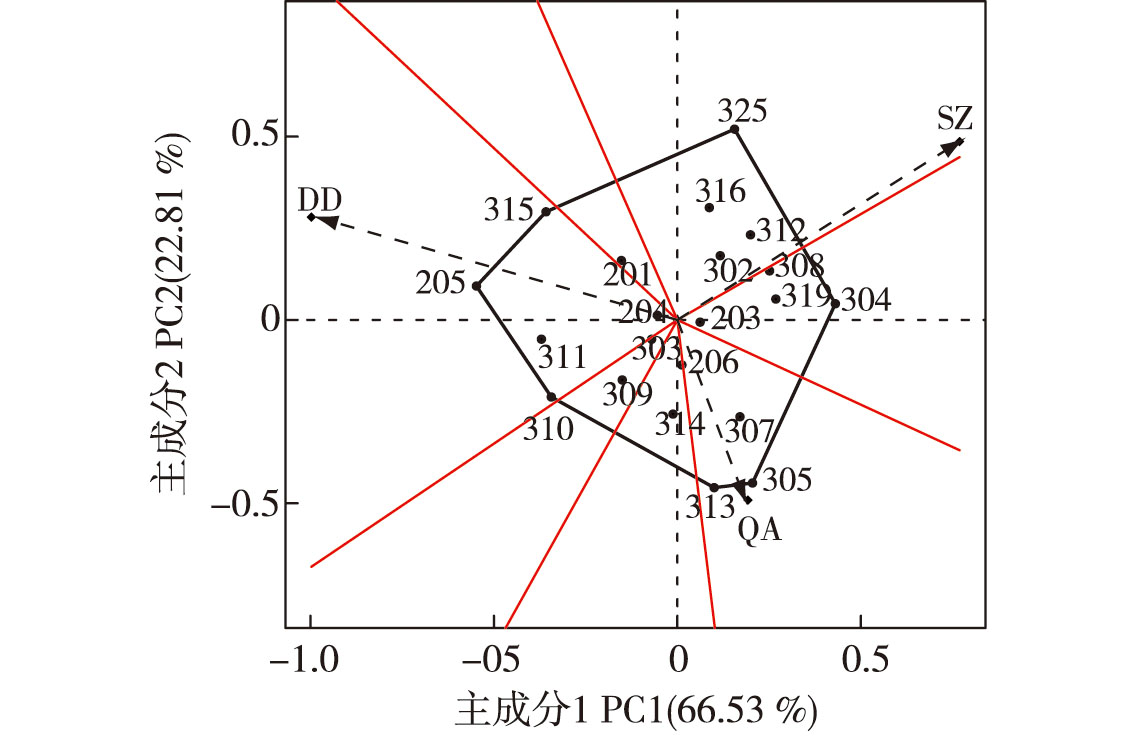
【Objective】The purpose of this study is to assess the growth characteristics and adaptability of (Betula platyphylla×B. pendula) half-sib families through regional trials conducted at different test sites, thereby providing scientific guidance for the selection and application of superior families as well as the reconstruction of seed orchards. Specifically, the study aims to clarify the genetic variation patterns of key growth traits among families and across environments, and to identify families with excellent growth performance and wide adaptability.【Method】The research materials are from 10-year-old tetraploid and diploid (B. platyphylla×B. pendula) half-sib family test forests located in Dandong, Shangzhi and Qing’an test sites. Traits including tree height, diameter at breast height (DBH), stem straightness, and survival rate were systematically investigated in each family. A heteroscedastic mixed linear model was applied to analyze the fixed effects (e.g., site effects) and random effects (e.g., family effects, block effects, and family×site interaction effects) of each trait across multiple sites. The combined best linear unbiased prediction-genotype main effect plus genotype×environment interaction (BLUP-GGE) analysis method was used to estimate the comprehensive breeding values of each family, while GGE biplot analysis was employed to evaluate the adaptability and stability of families across different test sites.【Result】(1) The site effects on tree height, DBH, individual tree volume, and stem straightness of (B. platyphylla×B. pendula) half-sib families were extremely significant (P<0.01). Except for stem straightness, the differences in other traits among families and blocks, as well as the family×site interaction effects, all reached significant levels (the ratio of variance component to standard error (z.ratio) ≥1.5), indicating obvious genetic differentiation and environmental adaptation differences among families. (2) Analysis of variance for each test site revealed that, except for the survival rate at Qing’an test site, the differences in all other traits among families were extremely significant (P<0.01). Among all traits at Dandong, Shangzhi, and Qing’an test sites, the individual tree volume exhibited the largest coefficient of variation, which was 72.37%, 56.37% and 49.86%, respectively, indicating the highest genetic variation and selection potential. (3) GGE biplot analysis indicated that the three test sites could be divided into three distinct suitable growth regions due to differences in environmental conditions. The families that performed best at Dandong, Qing’an, and Shangzhi test sites were family 205, 305 and 325, respectively. Compared with the average value of diploid families, their individual tree volume growth increased by 18.51%, 2.60% and 20.57%, respectively. Based on a 20% selection rate and comprehensive evaluation across the three test sites, families such as 325 and 316 were selected as superior families with fast growth and high stability, with the genetic gains of individual tree volume reaching 5.50% and 12.92%, respectively.【Conclusion】There were significant differences in various traits of (B. platyphylla×B. pendula) families between test sites and among families, indicating the strong genetic control and environmental sensitivity of these traits. Based on the BLUP-GGE biplot analysis of growth traits, the three test sites were classified into different suitable growth regions. Families 325 and 316 were identified as superior families with fast growth and high stability, which could provide valuable genetic resources for the genetic improvement and sustainable management of (B. platyphylla×B. pendula) plantations.
Betula platyphylla×B. pendula / tetraploid lineage / regional trial / growth characteristics and stability / BLUP-GGE biplot analysis
| [1] |
林元震. 林木基因型与环境互作的研究方法及其应用[J]. 林业科学, 2019, 55(5):142-151.
|
| [2] |
顾万春. 刺槐无性系G×E互作的研究:遗传稳定性和生长适应性的评价[J]. 林业科学研究, 1991, 4(6):623-628.
|
| [3] |
刘宇, 徐焕文, 尚福强, 等. 3个地点白桦种源试验生长稳定性分析[J]. 北京林业大学学报, 2016, 38(5):50-57.
|
| [4] |
晏姝, 胡德活, 郑会全, 等. 16年生杉木2代种子园家系区域测定分析[J]. 森林与环境学报, 2018, 38(4):414-418.
|
| [5] |
赵兴堂, 夏德安, 曾凡锁, 等. 水曲柳生长性状种源与地点互作及优良种源选择[J]. 林业科学, 2015, 51(3):140-147.
|
| [6] |
黄秦军, 苏晓华, 王胜东, 等. 杨树新品种‘渤丰1号’杨和‘渤丰2号’杨的综合评价[J]. 林业科学, 2014, 50(5):75-81.
|
| [7] |
|
| [8] |
|
| [9] |
|
| [10] |
|
| [11] |
|
| [12] |
|
| [13] |
|
| [14] |
程玲, 张心菲, 张鑫鑫, 等. 基于BLUP和GGE双标图的林木多地点试验分析[J]. 西北农林科技大学学报(自然科学版), 2018, 46(3):87-93.
|
| [15] |
郑聪慧, 张鸿景, 王玉忠, 等. 基于BLUP和GGE双标图的华北落叶松家系区域试验分析[J]. 林业科学, 2019, 55(8):73-83.
|
| [16] |
康向阳. 三倍体毛白杨新品种选育[J]. 北京林业大学学报, 2004, 26(3):40-63.
|
| [17] |
尚宗燕, 张继祖, 刘谦虎, 等. 漆树染色体观察及三倍体漆树的发现[J]. 西北植物学报, 1985, 5(3):187-191,252-253.
|
| [18] |
石华月, 邱长玉, 林强. 桑树三倍体杂交桑“桑特优2号” 制种园栽培管理技术及效益分析[J]. 广东蚕业, 2019, 53(7):6-7,12.
|
| [19] |
康向阳. 杜仲良种选育研究现状及展望[J]. 北京林业大学学报, 2017, 39(3):1-6.
|
| [20] |
林琳, 穆怀志, 姚启超, 等. 白桦不同杂交组合三倍体子代当年生苗木生长性状分析[J]. 北京林业大学学报, 2012, 34(5):1-5.
|
| [21] |
刘宇, 徐焕文, 姜静, 等. 基于种子活力及苗期生长性状的白桦四倍体半同胞家系初选[J]. 北京林业大学学报, 2014, 36(2):74-80.
|
| [22] |
徐焕文, 刘宇, 李雅婧, 等. 白桦三倍体制种园中各家系种子活力比较[J]. 西南林业大学学报, 2013, 33(5):34-39.
|
| [23] |
姜静, 穆怀志, 林琳. 白桦多倍体育种研究[M]. 北京: 科学出版社, 2018.
|
| [24] |
孟宪宇. 全国高等林业院校教材测树学 (林业专业用) (第2版)[M]. 北京: 中国林业出版社, 1996.
|
| [25] |
李金花. 基于BLUP和GGE双标图的黑杨派无性系生长性状基因型与环境互作效应[J]. 林业科学, 2021, 57(6):64-73.
|
| [26] |
林元震, 陈晓阳. R与ASReml-R统计分析教程[M]. 北京: 中国林业出版社, 2014.
|
| [27] |
顾万春. 统计遗传学[M]. 北京: 科学出版社, 2004.
|
| [28] |
刘宇, 徐焕文, 李志新, 等. 白桦子代家系幼林期生长表现及适应性分析[J]. 浙江农林大学学报, 2015, 32(6):853-860.
|
| [29] |
刘宇, 徐焕文, 滕文华, 等. 白桦全同胞子代测定及优良家系早期选择[J]. 北京林业大学学报, 2017, 39(2):1-8.
|
| [30] |
严威凯. 双标图分析在农作物品种多点试验中的应用[J]. 作物学报, 2010, 36(11):1805-1819.
|
| [31] |
许乃银, 荣义华, 李健, 等. GGE双标图在陆地棉高产稳产和适应性分析中的应用:以长江流域棉区国审棉花新品种‘鄂杂棉30’为例[J]. 中国生态农业学报, 2017, 25(6):884-892.
|
| [32] |
陈晓阳, 沈熙环. 林木育种学[M]. 北京: 高等教育出版社, 2005.
|
| [33] |
孙晓梅, 杨秀艳. 林木育种值预测方法的应用与分析[J]. 北京林业大学学报, 2011, 33(2):65-71.
|
| [34] |
|
| [35] |
|
| [36] |
|
| [37] |
康向阳. 林木三倍体育种研究进展及展望[J]. 中国科学:生命科学, 2020, 50(2):136-143.
|
| [38] |
|
| [39] |
欧阳芳群, 张守攻, 王军辉, 等. 补光处理对黑云杉不同种源苗木生长的影响[J]. 北京林业大学学报, 2010, 32(5):82-87.
|
| [40] |
贾忠奎, 马履一, 王小平. 北美白云杉、黑云杉在中国的引种研究[J]. 江西农业大学学报(自然科学), 2002, 24(3):340-345.
|
| [41] |
|
| [42] |
王军辉, 张守攻, 马常耕, 等. 云杉强化育苗技术的研究现状和展望[J]. 浙江林学院学报, 2005, 22(3):350-354.
|
| [43] |
|
| [44] |
|
/
| 〈 |
|
〉 |