PDF(6603 KB)

Spatial-temporal characteristics and influencing factors of urban park recreation vitality in Nanjing City
HUANG Ying, HONG Xiaojun, ZHENG Yan, LUO Zuhan, LI Zherui
Journal of Nanjing Forestry University (Natural Sciences Edition) ›› 2026, Vol. 50 ›› Issue (3) : 264-274.
PDF(6603 KB)
 PDF(6603 KB)
Spatial-temporal characteristics and influencing factors of urban park recreation vitality in Nanjing City
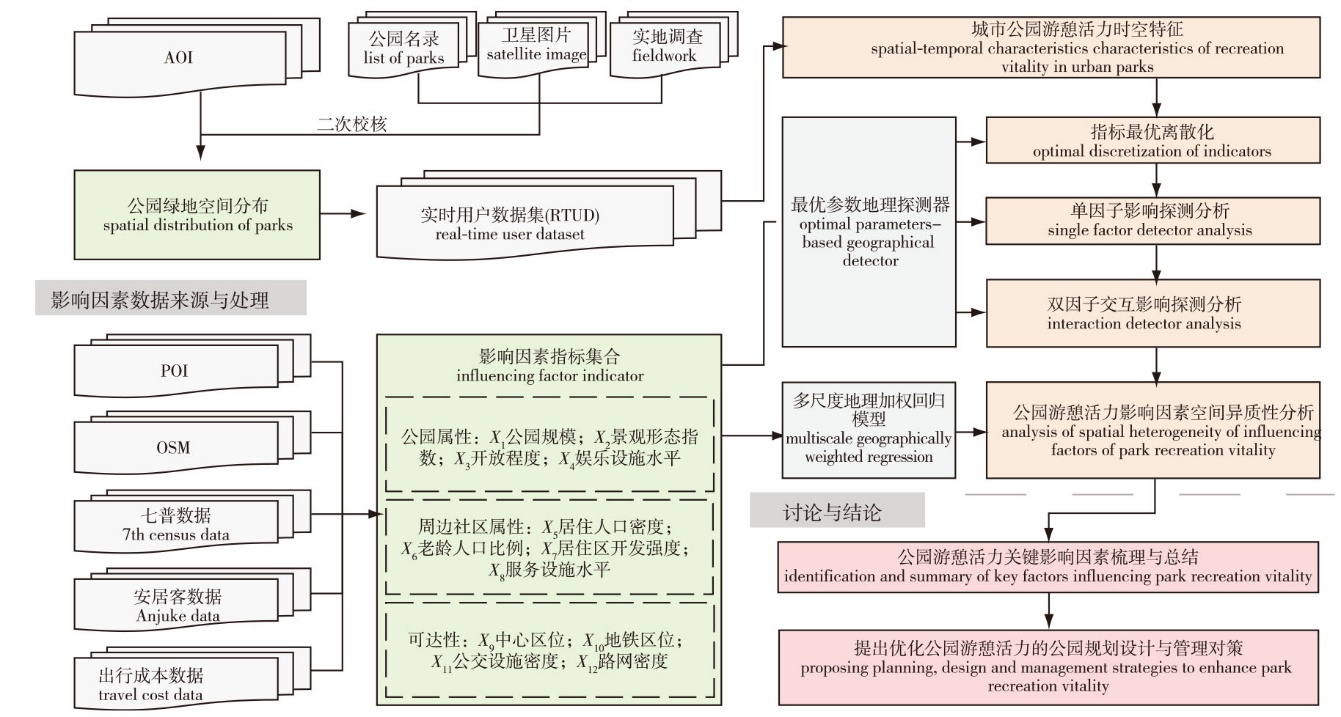
【Objective】An analysis of the characteristics and influencing factors of urban park recreational vitality can provide a basis for enhancing the benefits of city parks.【Method】Utilizing a multi-source dataset that includes real-time user dataset (RTUD), internet map travel data, and the seventh census data, this study employs the optimal parameters-based geographical detector (OPGD) and multiscale geographically weighted regression (MGWR) methods to analyze the spatiotemporal characteristics and influencing factors of recreational vitality in the Jiangnan Main City (Nanjing).【Result】(1) Spatially, the recreational vitality of parks exhibits a pattern of high central intensity with lower edges. (2) Temporally, scenic parks demonstrate higher recreational vitality on rest days, with more regular changes compared to workdays. (3) Overall, the interaction of dual factors provides a higher explanatory power for recreational vitality than single factors, with public transportation facilities being the dominant influencing factor on workdays, and park entertainment facilities on rest days. (4) The main influencing factors of park recreational vitality show spatial heterogeneity, generally characterized by central-peripheral and south-north differences.【Conclusion】Based on these findings, urban park planning should optimize temporal-spatial management, enhance transportation connectivity, provide tailored facilities for different park scales, and integrate multi-factor interactions.
urban park recreation vitality / real-time user dataset / optimal parameters-based geographical detector (OPGD) / multiscale geographically weighted regression (MGWR) / Nanjing City
| [1] |
|
| [2] |
邵钰涵, 卢慧霖. 基于多源数据的社区公园游憩规律及其空间特征关联研究:以上海为例[J]. 风景园林, 2024, 31 (2):32-40.
|
| [3] |
|
| [4] |
孔繁花, 尹海伟, 刘金勇, 等. 城市绿地降温效应研究进展与展望[J]. 自然资源学报, 2013, 28(1):171-181.
|
| [5] |
|
| [6] |
|
| [7] |
|
| [8] |
陶峥, 丁家辉, 王玲, 等. 城市公园特征对游憩活力影响的时空异质性研究[J]. 中国园林, 2023, 39(12):108-113.
|
| [9] |
周宇麒, 汪坚强, 齐羚, 等. 基于结构方程模型的公园安全感提升策略研究:以北京松榆里公园为例[J]. 中国园林, 2023, 39(6):95-100.
|
| [10] |
张艺鸽, 杨芳绒, 王梦瑶. 基于CPTED理论和空间句法的城市公园犯罪防控分析:以郑州市人民公园、紫荆山公园为例[J]. 西南大学学报(自然科学版), 2022, 44(1):202-212.
|
| [11] |
|
| [12] |
罗桑扎西, 甄峰. 基于手机数据的城市公共空间活力评价方法研究:以南京市公园为例[J]. 地理研究, 2019, 38(7):1594-1608.
|
| [13] |
魏迪, 陆毅, 汪原, 等. 信息流介入公共空间活力营造:基于城市公园的大数据循证分析[J]. 风景园林, 2023, 30(7):86-93.
|
| [14] |
|
| [15] |
刘瑞雪, 许晓雪. 城市公园植物景观空间活力及环境因素影响研究[J]. 中国园林, 2018, 34(S2):160-164.
|
| [16] |
徐欣, 胡静. 基于GPS数据城市公园游客时空行为研究:以武汉东湖风景区为例[J]. 经济地理, 2020, 40(6):224-232.
|
| [17] |
黄锰, 郑泽伟. 哈尔滨社区公园人流分布影响研究[J]. 低温建筑技术, 2024, 46(3):6-11.
|
| [18] |
秦诗文, 杨俊宴, 冯雅茹, 等. 基于多源数据的城市公园时空活力与影响因素测度:以南京为例[J]. 中国园林, 2021, 37(1):68-73.
|
| [19] |
|
| [20] |
叶永祥, 陈馨, 崔亭亭, 等. 基于耦合协调度的城市公园“线上-线下”活力空间特征与影响因素[J]. 天津师范大学学报(自然科学版), 2024, 44(3):53-59.
|
| [21] |
|
| [22] |
|
| [23] |
|
| [24] |
朱丹莉, 潘剑彬, 许传青. 高密度城区公园绿地景观环境特征与访客数量相关关系研究[J]. 现代城市研究, 2023, 38(10):119-123,132.
|
| [25] |
南京市绿化园林局. 南京市绿地系统规划(2013-2020))[R]. 南京: 南京市绿化园林局, 2017.
Nanjing Green and Garden Bureau. Nanjing greenspace system planning (2013-2020)[R]. Nanjing: Nanjing Green and Garden Bureau, 2017.
|
| [26] |
|
| [27] |
|
| [28] |
|
| [29] |
|
| [30] |
王恩旭, 周江, 杨俊, 等. 基于MGWR的街道尺度下建成环境对城市活力空间分异影响机制研究:以沈阳市中心城区为例[J]. 地理科学, 2024, 44(8):1322-1331.
|
| [31] |
孟醒, 申世广. 基于人的全生命周期的城市区级综合公园建成效果评价[J]. 南京林业大学学报(人文社会科学版), 2022, 22(3):95-106.
|
/
| 〈 |
|
〉 |