Phenotypic diversity and selection of superior strains from seven half-sib families of Malus including ‘Sweet Sugartyme’

YANG Xiaoqian, ZHANG Wangxiang, ZHOU Ting, ZHANG Long, LIU Ailin, XIONG Qingqing

Journal of Nanjing Forestry University (Natural Sciences Edition) ›› 2026, Vol. 50 ›› Issue (2) : 139-148.

PDF(2640 KB)
PDF(2640 KB)
Journal of Nanjing Forestry University (Natural Sciences Edition) ›› 2026, Vol. 50 ›› Issue (2) : 139-148. DOI: 10.12302/j.issn.1000-2006.202412043

Phenotypic diversity and selection of superior strains from seven half-sib families of Malus including ‘Sweet Sugartyme’

Author information +
History +

Abstract

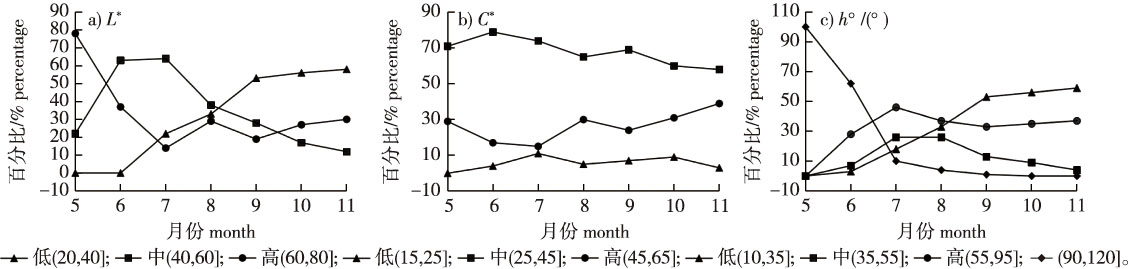
【Objective】For a long time, the breeding goal of crabapple has mainly centered on the flower traits, while its fruit ornamental value has been overlooked. To emphasize the fruit ornamental value of crabapple, we conducted experimental studies on the fruit Malus offspring like ‘Sweet Sugartyme’ and other crabapples. The aim was to explore the phenotypic characteristics of half-sib offspring and the effectiveness of breeding.【Method】Based on the weighted hierarchical analysis method(AHP), a comprehensive evaluation system for the ornamental value of crabapple offspring was established from four phenotypic dimensions, namely fruit, flower, tree form and leaf. The focus was on clarifying the characteristics of the offspring in terms of fruit color and phenology.【Result】(1) According to the fruit color at the ripening stage, the fruit colors of 100 single plants of the offspring at maturity can be divided into three categories and nine sub-categories.There are significant differences in the ornamental value of fruit colors at maturity among crabapple offspring of different colors/sub-colors series. (2) Compared with the mother population plants, the fruit fruiting period of the offspring population was relatively longer, and the proportion of late and very late-ripening type was significantly increased. According to the length of the fruiting period and the early and late ripening period of the fruit, the progeny population can be divided into five cultivar groups. (3) Based on the AHP comprehensive evaluation model, the progeny plants were classified into four grades. From grade Ⅰ to Ⅳ, the comprehensive ornamental properties of the progeny plants gradually weakened, superior individuals of grade Ⅰ, such as G45, G71, G70, etc., had bright fruit colors, a large fruit set, and a long fruiting period; although the two, G16 and G85, had relatively low comprehensive scores were very late-ripening, with a long fruiting period of 258 days and prominent single character traits, which made them exhibiting good for ornamental effects.【Conclusion】Through free pollination, the genetic base of the offspring population of half-sibling family lines can be effectively expanded, and the germplasm diversity can be significantly improved.The evaluation system constructed by AHP is more accurate, and can be used for the selection of new varieties of ornamental crabapple and the broadening of the ornamental value of crabapple.
Key words

ornamental crabapple (Malus spp.) / half-sib families / phenotypic / specificity / evaluation of superior strains / analytic hierarchy process(AHP)

Cite this article

Download Citations
YANG Xiaoqian , ZHANG Wangxiang , ZHOU Ting , et al . Phenotypic diversity and selection of superior strains from seven half-sib families of Malus including ‘Sweet Sugartyme’[J]. Journal of Nanjing Forestry University (Natural Sciences Edition). 2026, 50(2): 139-148 https://doi.org/10.12302/j.issn.1000-2006.202412043

References

[1]
TEIXEIRA D S J A, GULYÁS A, MAGYAR-TÁBORI K, et al. In vitro tissue culture of apple and other Malus species:recent advances and applications[J]. Planta, 2019, 249(4):975-1006. DOI: 10.1007/s00425-019-03100-x.
[2]
WANG S, YANG J, ZHANG B, et al. The complete chloroplast genome sequence of Malus halliana (Rosaceae),an important ornamental plant[J]. Mitochondrial DNA Part B, 2020, 5(3):2155-2156. DOI: 10.1080/23802359.2020.1768936.
[3]
王璐. 36份观赏海棠的倍性分析与表型多样性评价[D]. 秦皇岛: 河北科技师范学院, 2022. DOI: 10.27741/d.cnki.ghbkj.2022.000109.
WANG L. Evaluation of 36 ornamental crabapple ploidy analysis and phenotypic diversity[D]. Qinhuangdao: Hebei Normal University of Science & Technology, 2022. DOI: 10.27741/d.cnki.ghbkj.2022.000109.
[4]
李亚楠. 苹果属(Malus Mill)种间关系的分子系统学研究[D]. 哈尔滨: 东北林业大学, 2021. DOI: 10.27009/d.cnki.gdblu.2021.000253.
LI Y N. Molecular Systematics Study on Interspecific Relationship of Malus Mill[D]. Harbin: Northeast Forestry University, 2021. DOI: 10.27009/d.cnki.gdblu.2021.000253.
[5]
毕玉科, 张杰, 张春英. 上海地区北美海棠冬季观果品种筛选[J]. 浙江农业科学, 2023, 64(11):2714-2718.
BI Y K, ZHANG J, ZHANG C Y. Variety screening of winter fruit-ornamental effect of Northern American Begonia in Shanghai[J]. Journal of Zhejiang Agricultural Sciences, 2023, 64(11):2714-2718. DOI: 10.16178/j.issn.0528-9017.20221256.
[6]
ZHOU T, ZHANG W X, ZHANG D L, et al. A binary-based matrix model for Malus corolla symmetry and its variational significance[J]. Frontiers in Plant Science, 2020, 11:416. DOI: 10.3389/fpls.2020.00416.
[7]
SUN T, CHEN Y, ZHANG W, et al. ‘Yanyu Jiangnan’ Crabapple[J]. HortScience, 2023, 58(5):588-589. DOI: 10.21273/HORTSCI17124-23.
[8]
张全全, 张龙, 李丽娟, 等. 观赏海棠自由授粉子代花色特征及选优[J]. 东北林业大学学报, 2021, 49(8):56-59,77.
ZHANG Q Q, ZHANG L, LI L J, et al. Selection of color characteristics of free pollinated progeny of ornamental crabapple[J]. Journal of Northeast Forestry University, 2021, 49(8):56-59,77. DOI: 10.13759/j.cnki.dlxb.2021.08.011.
[9]
杜文文. 观叶秋海棠新品种选育[J]. 中国花卉园艺, 2019(10):35.
DU W W. Selection and breeding of new varieties of leaf-viewing crabapple[J]. China Flowers & Horticulture, 2019(10):35.
[10]
EMERIEWEN O F, WÖHNER T, FLACHOWSKY H, et al. Malus hosts-Erwinia amylovora interactions:strain pathogenicity and resistance mechanisms[J]. Frontiers in Plant Science, 2019, 10:551. DOI: 10.3389/fpls.2019.00551.
[11]
ZHOU T, FAN J J, ZHAO M M, et al. Phenotypic variation of floral organs in Malus using frequency distribution functions[J]. BMC Plant Biology, 2019, 19(1):574. DOI: 10.1186/s12870-019-2155-6.
[12]
JUNG M, HODEL M, KNAUF A, et al. Evaluation of genomic and phenomic prediction for application in apple breeding[J]. BMC Plant Biology, 2025, 25(1):103. DOI: 10.1186/S12870-025-06104-W.
[13]
MOREIRA R A, RODRIGUES M A, DE SOUZA R C, et al. Natural and artificial pollination of white-fleshed pitaya[J]. Anais da Academia Brasileira de Ciências, 2022, 94(S3):e20211200. DOI: 10.1590/0001-3765202220211200.
[14]
RONG H, HUANG B, HAN X, et al. Pedigree reconstruction and genetic analysis of major ornamental characters of ornamental crabapple (Malus spp.) based on paternity analysis[J]. Scientific Reports, 2022, 12:14093. DOI: 10.1038/s41598-022-18352-z.
[15]
ABBATE A P, CAMPBELL J W, WILLIAMS G R. Artificial pollination of kiwifruit (Actinidia Chinensis planch.var.chinensis) (ericales:Actinidiaceae) results in greater fruit set compared to flowers pollinated by managed bees (Apis Mellifera L.(hymenoptera:Apidae) and Bombus impatiens Cresson (hymenoptera:Apidae))[J]. Journal of Economic Entomology, 2023, 116(3):674-685. DOI: 10.1093/jee/toad044.
[16]
KIM S H, DO H, CHO G, et al. Bacterial community structure and the dominant species in imported pollens for artificial pollination[J]. Plant Pathology Journal, 2021, 37(3):299-306. DOI: 10.5423/ppj.nt.02.2021.0029.
[17]
LEAL J E. AHP-express:a simplified version of the analytical hierarchy process method[J]. MethodsX, 2019, 7:100748. DOI: 10.1016/j.mex.2019.11.021.
[18]
ROUSSEAU-GUEUTIN M, MORICE J, CORITON O, et al. The impact of open pollination on the structural evolutionary dynamics,meiotic behavior,and fertility of resynthesized Allotetraploid Brassica napusL[J]. Genes Genomes Genetics, 2017, 7(2):705-717. DOI: 10.1534/g3.116.036517.
[19]
张往祥, 范俊俊, 杨萍, 等. ‘紫王子’海棠半同胞家系苗期表型特征分析[J]. 南京林业大学学报(自然科学版), 2017, 41(6):33-40.
ZHANG W X, FAN J J, YANG P, et al. Analysis of phenotypic characteristics of the Malus ‘Purple Prince’ half-sib progenies at the seedling stage[J]. Journal of Nanjing Forestry University (Natural Sciences Edition), 2017, 41(6):33-40. DOI: 10.3969/j.issn.1000-2006.201708012.
[20]
张往祥, 江志华, 裘靓, 等. 观赏海棠花色时序动态分布格局研究[J]. 园艺学报, 2013, 40(3):505-514.
ZHANG W X, JIANG Z H, QIU J, et al. Studies on sequence dynamic distribution pattern of flower color parameters of ornamental crabapple[J]. Acta Horticulturae Sinica, 2013, 40(3):505-514. DOI: 10.16420/j.issn.0513-353x.2013.03.015.
[21]
杨祎凡, 周婷, 范俊俊, 等. 基于切花应用的观赏海棠品种评价与筛选[J]. 南京林业大学学报(自然科学版), 2019, 43(4):70-76.
YANG Y F, ZHOU T, FAN J J, et al. Cultivar evaluation and selection in ornamental crabapple for cut flower application[J]. Journal of Nanjing Forestry University (Natural Sciences Edition), 2019, 43(4):70-76. DOI: 10.3969/j.issn.1000-2006.201803044.
[22]
李欣, 沈向, 张鲜鲜, 等. 观赏海棠叶、果、花色彩的数字化描述[J]. 园艺学报, 2010, 37(11):1811-1817.
LI X, SHEN X, ZHANG X X, et al. Digital description of the ornamental crabapple’s leaf,fruit and flower color[J]. Acta Horticulturae Sinica, 2010, 37(11):1811-1817. DOI: 10.16420/j.issn.0513-353x.2010.11.021.
[23]
赵圃圃, 张全全, 江皓, 等. 观赏海棠叶色动态变化及色彩分类研究[J]. 福建农业学报, 2020, 35(8):845-850.
ZHAO P P, ZHANG Q Q, JIANG H, et al. Changes and classification on leaf color of ornamental crabapple[J]. Fujian Journal of Agricultural Sciences, 2020, 35(8):845-850. DOI: 10.19303/j.issn.1008-0384.2020.08.005.
[24]
UNNO T, SUGIMOTO A, KAKUDA T. Xanthine oxidase inhibitors from the leaves of Lagerstroemia speciosa (L.) Pers[J]. Journal of Ethnopharmacology, 2004, 93(2/3):391-395. DOI: 10.1016/j.jep.2004.04.012.
[25]
WHITE S A, SCOGGINS H L. Fertilizer concentration affects growth response and leaf color of Tradescantia virginiana L[J]. Journal of Plant Nutrition, 2005, 28(10):1767-1783. DOI: 10.1080/01904160500250896.
[26]
BYAMUKAMA R, JORDHEIM M, KIREMIRE B, et al. Anthocyanins from flowers of Hippeastrum cultivars[J]. Scientia Horticulturae, 2006, 109(3):262-266. DOI: 10.1016/j.scienta.2006.05.007.
[27]
CIE Technical Report (Draft). Method for deriving colour differences in images[R]. Vienna, Austria: Central Bureau of the CIE, 2008.
[28]
刘一娜. 海棠品种性状规范性描述与数据库构建研究[D]. 北京: 中国林业科学研究院, 2018.
LIU Y N. Studies of Sandard Description and Database Construction of Malus Cultivars[D]. Beijing: Chinese Academy of Forestry, 2018.
[29]
夏方丽. 西北农大南校区春季观花木本植物花期物候观测与分析[J]. 南方农业, 2023, 17(15):58-61.
XIA F L. Observation and analysis of flowering period phenology of spring flowering woody plants on the south campus of Northwest Agricultural University[J]. South China Agriculture, 2023, 17(15):58-61. DOI: 10.19415/j.cnki.1673-890x.2023.15.012.
[30]
杨春胤, 雷利锋, 刘新伟, 等. 应用层次分析法建立微型盆栽月季品种综合评价体系[J]. 农业科学研究, 2018, 39(4):89-93.
YANG C Y, LEI L F, LIU X W, et al. Applying analytic hierarchy process to establish a comprehensive evaluation system of micro-potted roses varieties[J]. Journal of Agricultural Sciences, 2018, 39(4):89-93. DOI: 10.13907/j.cnki.nykxyj.2018.04.012.
[31]
王之妍, 沈留记, 田佳禾, 等. 南疆5个枣品种物候特性的观测[J]. 果树资源学报, 2024, 5(1):17-22.
WANG Z J, SHEN L J, TIAN J H, et al. Observation of the phenological Characteristics of Five Jujube cultivars in Southern Xinjiang[J]. Journal of Fruit Resource, 2024, 5(1):17-22. DOI: 10.16010/j.cnki.14-1127/s.2024.01.017.
[32]
刘胜男. 观赏海棠表型多样性分析与评价[D]. 郑州: 河南农业大学, 2022. DOI: 10.27117/d.cnki.ghenu.2022.000031.
LIU S N. Analysis and evaluation of phenotypic diversity of ornamental crabapple[D]. Zhengzhou: Henan Agricultural University, 2022. DOI: 10.27117/d.cnki.ghenu.2022.000031.
[33]
曲晓玲, 李晓磊, 于之庆, 等. 不同观赏海棠品种的花粉及授粉特性研究[J]. 落叶果树, 2006, 38(2):46-48.
QU X L, LI X L, YU Z Q, et al. Pollen and pollination characteristics of different ornamental crabapple varieties[J]. Deciduous Fruits, 2006, 38(2):46-48. DOI: 10.3969/j.issn.1002-2910.2006.02.022.
[34]
HUMPHRIES C J, MURRAY B G, BOCQUET G, et al. Chromosome numbers of phanerogams.7[J]. Annals of the Missouri Botanical Garden, 1977, 64(1):142. DOI: 10.2307/2395245.
[35]
李欣, 姜红卫, 刘敬阳, 等. 不同类型荷花杂交、开放授粉、自交结实性及出苗率研究[J]. 江西农业学报, 2013, 25(4):43-45,48.
LI X, JIANG H W, LIU J Y, et al. Study on hybridization,open pollination,selfing fecundity and emergence rate of different types of Lotus[J]. Acta Agriculturae Jiangxi, 2013, 25(4):43-45,48. DOI: 10.19386/j.cnki.jxnyxb.2013.04.013.
[36]
GVARYAHU G, ROBINZON B, MELTZER A, et al. Artificial insemination and natural mating in the crossbreeding of the Muscovy drake and the Pekin duck[J]. Poultry Science, 1984, 63(2):386-387. DOI: 10.3382/ps.0630386.
PDF(2640 KB)

Accesses

Citation

Detail

Sections
Recommended
The full text is translated into English by AI, aiming to facilitate reading and comprehension. The core content is subject to the explanation in Chinese.

/