PDF(2076 KB)

Changes of particulate organic carbon and mineral-associated organic carbon in rhizosphere and bulk soil of poplar plantation under nitrogen deposition
Gao Xueping, Liu Huihui, Shi Zheng, Fang Yu, Ruan Honghua, Shen Caiqin, Xu Yaming, Huo Jianjun, Cao Guohua
Journal of Nanjing Forestry University (Natural Sciences Edition) ›› 2026, Vol. 50 ›› Issue (4) : 136-145.
PDF(2076 KB)
 PDF(2076 KB)
Changes of particulate organic carbon and mineral-associated organic carbon in rhizosphere and bulk soil of poplar plantation under nitrogen deposition
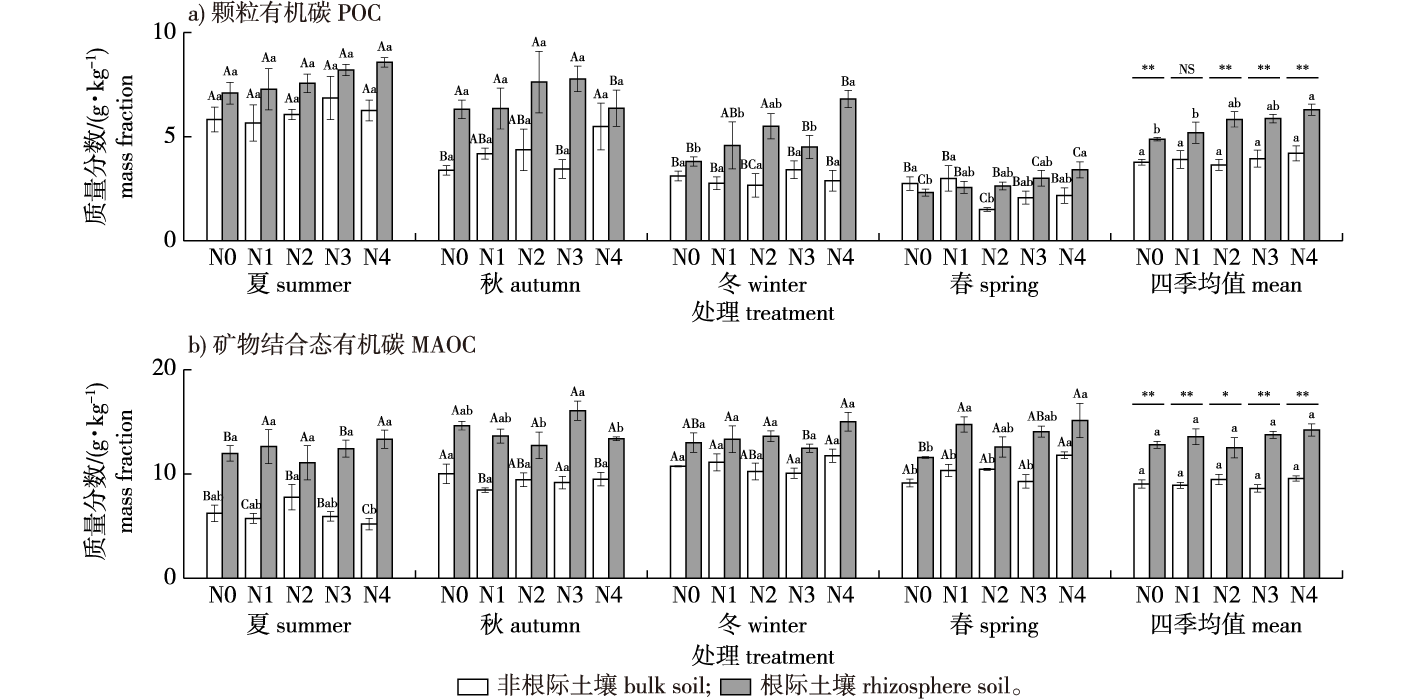
【Objective】Global nitrogen deposition may have significant impacts on ecosystem functions. Studying the differences in soil organic carbon (SOC) between rhizosphere and bulk soils and their responses to nitrogen deposition can provide a theoretical basis for further understanding the response and adaptation mechanisms of forest SOC cycling under future nitrogen deposition scenarios.【Method】Taking the poplar plantation as the object, five nitrogen deposition treatments [0, 5, 10, 15, 30 g/(m2·a), denoted as: N0, N1, N2, N3, N4] were set up in May 2012, and simulated nitrogen deposition treatments were carried out every year starting from that year. Soil samples from the rhizosphere and bulk were collected in July 2023 (summer, vigorous growth period), October 2023 (autumn, growth end period), January 2024 (winter, non-growth period), and April 2024 (spring, early growth period). Determine the contents of soil particulate organic carbon (POC), mineral-associated organic carbon (MAOC), SOC, pH, soil moisture content (SWC), microbial biomass carbon and nitrogen (MBC, MBN), total nitrogen (TN), and other related soil physical and chemical properties. Based on analysis of variance, independent sample T-test, correlation analysis and redundancy analysis, etc., the variation characteristics of POC and MAOC in rhizosphere and bulk soils under nitrogen deposition treatment were quantified, and the key factors driving the changes in their contents were analyzed.【Result】(1)Nitrogen deposition increased the POC concentration in rhizosphere soil. Compared with the N0 treatment, the annual average POC concentration in rhizosphere soil increased by 6.35% (N1), 19.46% (N2), 20.28% (N3), and 28.83% (N4). Nitrogen deposition had no effect on the POC concentration in bulk soil. Nitrogen deposition had no significant effect on the MAOC concentration in rhizosphere and bulk soils and the ratios of POC/SOC and MAOC/SOC. Seasonally, the POC concentration in rhizosphere and bulk soils showed significant seasonal differences, specifically summer > autumn > winter > spring; MAOC did not show significant seasonal differences. (2)Under the same nitrogen deposition treatment, the annual average POC concentration in rhizosphere soil was 29.51% (N0), 33.06% (N1), 59.90% (N2), 48.77% (N3), and 49.67% (N4) higher than that in bulk soil, and the annual average MAOC concentration in rhizosphere soil was 41.78% (N0), 52.45% (N1), 32.05% (N2), 59.73% (N3), and 48.63% (N4) higher than that in bulk soil. (3)Redundancy analysis revealed that pH, SOC, and SWC were the key factors driving the changes in POC and MAOC concentration in bulk soil, while MBC, pH, MBN, and TN were the key factors driving the changes in POC and MAOC concentration in rhizosphere soil.【Conclusion】Nitrogen deposition increased the POC concentration in rhizosphere soil, but had no significant effect on the POC and MAOC concentration in bulk soil and the MAOC concentration in rhizosphere soil. Under all nitrogen treatments, the POC and MAOC concentration in rhizosphere soil were higher than those in bulk soil. The results of this study reveal the differences in the main components of rhizosphere and bulk SOC and their different responses to nitrogen deposition, which can provide a theoretical basis for further exploring the response characteristics of SOC to nitrogen deposition.
poplar plantation / nitrogen deposition / rhizosphere soil / bulk soil / particulate organic carbon / mineral-associated organic carbon
| [1] |
方华, 莫江明. 氮沉降对森林凋落物分解的影响[J]. 生态学报, 2006, 26(9):3127-3136.
|
| [2] |
|
| [3] |
姜铭楷, 马书琴, 熊艳云, 等. 氮沉降驱动下凋落物分解对毛竹林土壤有机碳组分的影响[J]. 应用生态学报, 2024, 35(11):2983-2991.
|
| [4] |
|
| [5] |
|
| [6] |
|
| [7] |
|
| [8] |
|
| [9] |
|
| [10] |
张英, 张常洪, 汪其同, 等. 氮沉降下西南山地针叶林根际和非根际土壤固碳贡献差异[J]. 植物生态学报, 2023, 47(9):1234-1244.
|
| [11] |
邬子俊. 氮磷添加对亚热带常绿阔叶林根际土壤有机碳及微生物残体碳积累特征的影响[D]. 南昌: 江西农业大学, 2023.
|
| [12] |
|
| [13] |
|
| [14] |
张英, 张常洪, 汪其同, 等. 氮沉降下西南山地针叶林根际和非根际土壤微生物养分限制特征差异[J]. 植物生态学报, 2022, 46(4):473-483.
|
| [15] |
|
| [16] |
|
| [17] |
|
| [18] |
|
| [19] |
|
| [20] |
|
| [21] |
|
| [22] |
|
| [23] |
|
| [24] |
|
| [25] |
|
| [26] |
|
| [27] |
|
| [28] |
万猛, 田大伦, 樊巍. 豫东平原杨-农复合系统凋落物的数量、组成及其动态[J]. 生态学报, 2009, 29(5):2507-2513.
|
| [29] |
|
| [30] |
|
| [31] |
|
| [32] |
|
| [33] |
席本野. 杨树根系形态、分布、动态特征及其吸水特性[J]. 北京林业大学学报, 2019, 41(12):37-49.
|
| [34] |
|
| [35] |
LY/T 1232—2015 森林土壤磷的测定[S].
|
| [36] |
胡建文, 刘常富, 勾蒙蒙, 等. 林龄对马尾松人工林微生物残体碳积累的影响机制[J]. 应用生态学报, 2024, 35(1):153-160.
|
| [37] |
赵维俊, 刘贤德, 车宗玺, 等. 祁连山东段青海云杉林土壤有效氮研究[J]. 水土保持通报, 2011, 31(4):99-102.
|
| [38] |
|
| [39] |
赵天启. 放牧强度对荒漠草原土壤有机碳特征的影响及其机制[D]. 呼和浩特: 内蒙古农业大学, 2022.
|
| [40] |
肖若瑜, 阮宏华, 刘晖晖, 等. 干旱对杨树人工林土壤颗粒有机碳和矿物结合态有机碳的影响[J]. 南京林业大学学报(自然科学版), 2025, 49(5):55-64.
|
| [41] |
|
| [42] |
安宇超, 顾宇晨, 张茜, 等. 长期氮添加对苏北杨树人工林碳储量的影响[J]. 水土保持研究, 2024, 31(2):27-32,42.
|
| [43] |
彭赛. 氮添加对杨树人工林凋落物分解过程的影响[D]. 南京: 南京林业大学, 2016.
|
| [44] |
王杰. 氮添加对黄土丘陵区白羊草根际碳转化的影响机制[D]. 杨凌: 西北农林科技大学, 2022.
|
| [45] |
|
| [46] |
|
| [47] |
|
| [48] |
|
| [49] |
|
| [50] |
|
| [51] |
郝江勃, 乔枫, 蔡子良. 亚热带常绿阔叶林土壤活性有机碳组分季节动态特征[J]. 生态环境学报, 2019, 28(2):245-251.
|
| [52] |
|
| [53] |
|
| [54] |
|
| [55] |
宇文佩瑶. 黄土丘陵区典型林分土壤有机碳稳定性、酶活性和微生物群落的季节动态[D]. 西安: 西安理工大学, 2024.
|
| [56] |
|
/
| 〈 |
|
〉 |