PDF(2834 KB)

Effects of thinning intensity on stand structure of Pinus koraiensis natural secondary forest in Changbai Mountain region
JIANG Yuxi, WANG Shoutao, SHEN Fangyuan, ZHANG Peng, GU Jiacun, LIU Rendong, SONG Yilin, YANG Lixue
Journal of Nanjing Forestry University (Natural Sciences Edition) ›› 2026, Vol. 50 ›› Issue (2) : 167-178.
PDF(2834 KB)
 PDF(2834 KB)
Effects of thinning intensity on stand structure of Pinus koraiensis natural secondary forest in Changbai Mountain region
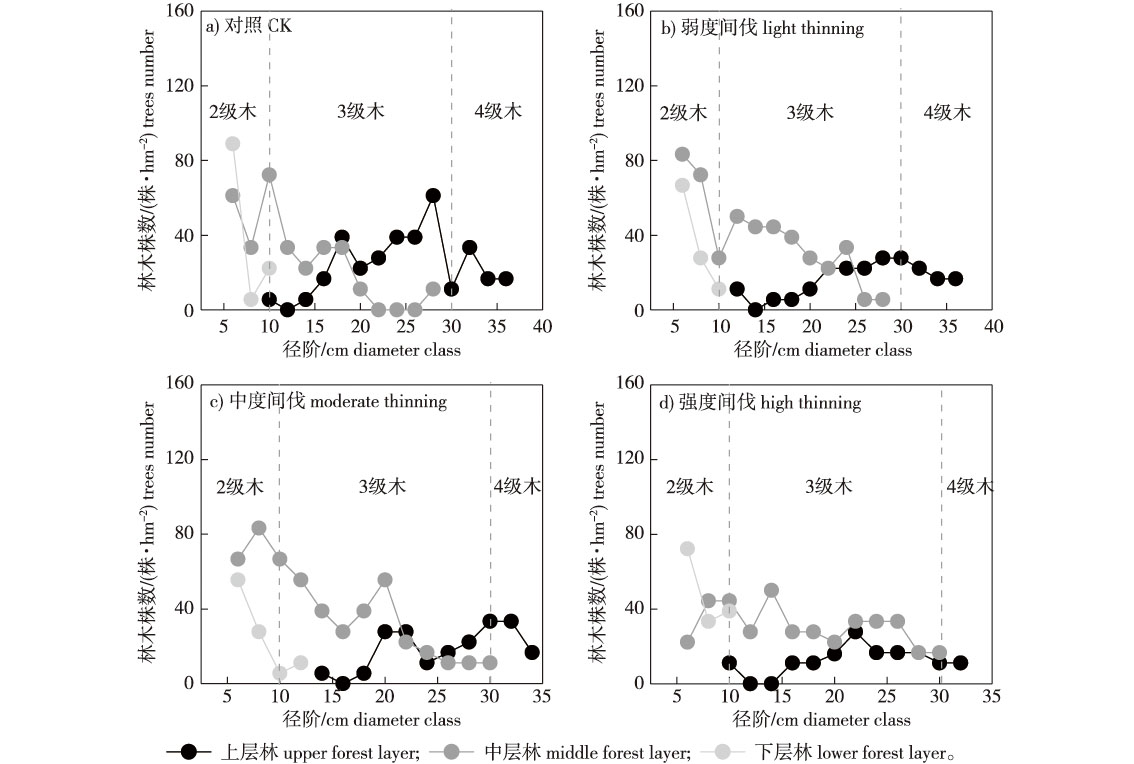
【Objective】This study aims to determine the appropriate thinning intensity for Pinus koraiensis broadleaved forests in the Changbai Mountain region from a stand structural perspective, providing scientific support for improving the quality and ecological functions of natural secondary Pinus koraiensis forest resources in this region.【Method】P. koraiensis broadleaved forests in the Changbai Mountain region were selected as the study subject. In 2014, different thinning intensities were applied (control (no thinning), light, moderate, and heavy thinning). Using tally data from 2022, we analyzed the changes in the vertical and spatial structure of the forest stands along the thinning gradient. A comprehensive evaluation of the spatial structure for each thinning treatment was conducted using the unit circle and squared mean distance index (FSS), and the optimization degree of different management intensity on stand structure was discussed.【Result】(1) Thinning promoted the growth of trees in the middle canopy layer. Under light and moderate thinning, the peak of the diameter distribution curve shifted rightward, and the tree diameter increased by 16.02% and 20.94% respectively compared with the control. All thinning intensities facilitated the accumulation of P. koraiensis volume in the middle forest layer. (2) The zero-order distribution results indicated that stand crowding gradually decreased with increasing thinning intensity, while mingling initially, increased and then began to decline under moderate thinning. (3) The multivariate distribution results showed that, relative to the control, light thinning increased the proportion of sparsely and randomly distributed individuals among the four major tree species by 25.44%. Moderate thinning mainly altered the horizontal distribution patterns and size differentiation, resulting in a 30.60% increase in the proportion of subdominant trees. Heavy thinning primarily affected crowding, increasing the proportion of individuals in a very sparse state from 8.17% to 40.11%. (4) Comprehensive forest spatial structure evaluation revealed that thinning improved certain structural attributes; however, only light thinning enhanced overall spatial structural quality.【Conclusion】Light thinning most effectively optimized stand spatial patterns in natural secondary Pinus koraiensis broadleaved forests, enhanced canopy stratification complexity, and facilitated the growth of small- and medium-sized trees. It also strengthened the competitive dominance of P. koraiensis, thereby accelerating positive forest succession.
thinning / Pinus koraiensis broadleaved forests / spatial structure / forest layer / comprehensive evaluation / community succession / Changbai Mountain region
| [1] |
|
| [2] |
|
| [3] |
|
| [4] |
惠刚盈, 张连金, 胡艳波, 等. 林分拥挤度及其应用[J]. 北京林业大学学报, 2016, 38(10):1-6.
|
| [5] |
|
| [6] |
陈哲, 魏浩亮, 周庆营, 等. 抚育间伐对华北落叶松人工林林分结构的影响[J]. 中南林业科技大学学报, 2022, 42(5):54-64.
|
| [7] |
赵衍征, 李耀翔, 李春旭, 等. 间伐作业对天然次生林林分结构特征的影响[J]. 中南林业科技大学学报, 2021, 41(3):83-95,110.
|
| [8] |
|
| [9] |
王芸, 赵鹏祥, 杨永辉, 等. 间伐对华北落叶松林林分结构稳定性的影响[J]. 西北林学院学报, 2022, 37(2):193-199.
|
| [10] |
王智勇, 董希斌, 张甜, 等. 抚育间伐强度对落叶松天然次生林林分结构及健康的影响[J]. 东北林业大学学报, 2018, 46(11):1-7.
|
| [11] |
张晓红, 周超凡, 张状, 等. 崇礼冬奥核心区华北落叶松人工林结构特征与优化模拟[J]. 林业科学, 2022, 58(10):79-88.
|
| [12] |
张君钰, 杨培华, 李卫忠, 等. 油松林林分空间结构分析及评价指数构建[J]. 西北林学院学报, 2020, 35(5):166-172.
|
| [13] |
惠刚盈. 基于相邻木关系的林分空间结构参数应用研究[J]. 北京林业大学学报, 2013, 35(4):1-9.
|
| [14] |
|
| [15] |
|
| [16] |
马双娇, 王庆成, 崔东海, 等. 抚育间伐对水曲柳天然林群落结构及植物多样性的影响[J]. 东北林业大学学报, 2019, 47(2):1-7.
|
| [17] |
朱子卉, 杨华, 张恒, 等. 择伐后落叶松云冷杉林直径结构及生长的动态变化[J]. 北京林业大学学报, 2018, 40(5):55-62.
|
| [18] |
和敬渊, 王新杰, 王开, 等. 杨桦次生林林分空间结构参数多元分布研究[J]. 北京林业大学学报, 2021, 43(2):22-33.
|
| [19] |
李存庆, 董灵波, 刘兆刚. 抚育采伐强度对天然落叶松林林分结构和蓄积的影响[J]. 东北林业大学学报, 2021, 49(5):1-5.
|
| [20] |
|
| [21] |
李建, 彭鹏, 何怀江, 等. 采伐对吉林蛟河针阔混交林空间结构的影响[J]. 北京林业大学学报, 2017, 39(9):48-57.
|
| [22] |
惠刚盈, 赵中华, 胡艳波, 等. 基于结构参数均值的林分空间结构综合评价研究[J]. 林业科学研究, 2023, 36(2):12-21.
|
| [23] |
|
| [24] |
|
| [25] |
|
| [26] |
|
| [27] |
|
| [28] |
陈杰. 闽北不同发育阶段青冈各林层树种组成与多样性[J]. 亚热带资源与环境学报, 2023, 18(4):34-41.
|
| [29] |
鲁姝月, 张小梅, 罗可馨, 等. 不同立地类型的柏木人工林空间结构分析[J]. 森林与环境学报, 2024, 44(5):511-520.
|
| [30] |
肖欢, 叶尔江·拜克吐尔汗, 张春雨, 等. 长白山阔叶红松林林层群落结构与生产力的关系[J]. 林业科学, 2024, 60(3):57-64.
|
| [31] |
胡松, 朱光玉, 陈振雄, 等. 基于林层划分的湖南栎类天然次生林断面积生长模型[J]. 林业科学, 2020, 56(9):184-192.
|
| [32] |
郝占庆, 李步杭, 张健, 等. 长白山阔叶红松林样地(CBS):群落组成与结构[J]. 植物生态学报, 2008, 32(2):238-250.
|
| [33] |
耿绍波, 汪兆洋, 赵秀海, 等. 长白山原始阔叶红松林主要乔木树种垂直结构分形分析[J]. 东北林业大学学报, 2013, 41(10):50-53,59.
|
| [34] |
吴俊多, 沈松, 李莲芳, 等. 畹町林场柚木中龄林疏伐前后的林分结构变化分析[J]. 甘肃农业大学学报, 2020, 55(6):117-123,130.
|
| [35] |
|
| [36] |
郑鸣鸣, 任正标, 王友良, 等. 间伐强度对杉木中龄林生长和结构的影响[J]. 森林与环境学报, 2020, 40(4):369-376.
|
| [37] |
|
| [38] |
|
| [39] |
鲁君悦. 吉林蛟河针阔混交林垂直结构变化及其与生产力关系研究[D]. 北京: 北京林业大学, 2021.
|
| [40] |
黄伟程, 高露双, 赵冰倩. 不同间伐强度下竞争对东北阔叶红松林主要树种生长-气候关系的影响[J]. 北京林业大学学报, 2023, 45(1):30-39.
|
| [41] |
|
| [42] |
郭利平, 姬兰柱, 王珍, 等. 长白山红松阔叶林不同演替阶段优势种的变化[J]. 应用生态学报, 2011, 22(4):866-872.
|
| [43] |
张悦, 郭利平, 易雪梅, 等. 长白山北坡3个森林群落主要树种种间联结性[J]. 生态学报, 2015, 35(1):106-115.
|
| [44] |
|
| [45] |
周蔚, 杨华, 亢新刚, 等. 择伐强度对长白山区天然云冷杉针阔混交林空间结构的影响[J]. 西北林学院学报, 2012, 27(4):7-12.
|
| [46] |
朱玉杰, 董希斌. 大兴安岭地区落叶松用材林不同抚育间伐强度经营效果评价[J]. 林业科学, 2016, 52(12):29-38.
|
| [47] |
姜廷山, 王鹤智, 董灵波, 等. 不同抚育强度对兴安落叶松林空间结构的影响[J]. 东北林业大学学报, 2018, 46(12):9-14,19.
|
| [48] |
|
| [49] |
|
| [50] |
|
| [51] |
|
/
| 〈 |
|
〉 |