PDF(6832 KB)

Changes in community structures and characteristics of Pinus armandi at different stages of pest infestation
LI Huanhuan, CUI Hongxia, ZHENG Jingjin, HU Wenjie, WANG Ben, ZENG Chi, SONG Yunrui
Journal of Nanjing Forestry University (Natural Sciences Edition) ›› 2026, Vol. 50 ›› Issue (3) : 247-256.
PDF(6832 KB)
 PDF(6832 KB)
Changes in community structures and characteristics of Pinus armandi at different stages of pest infestation
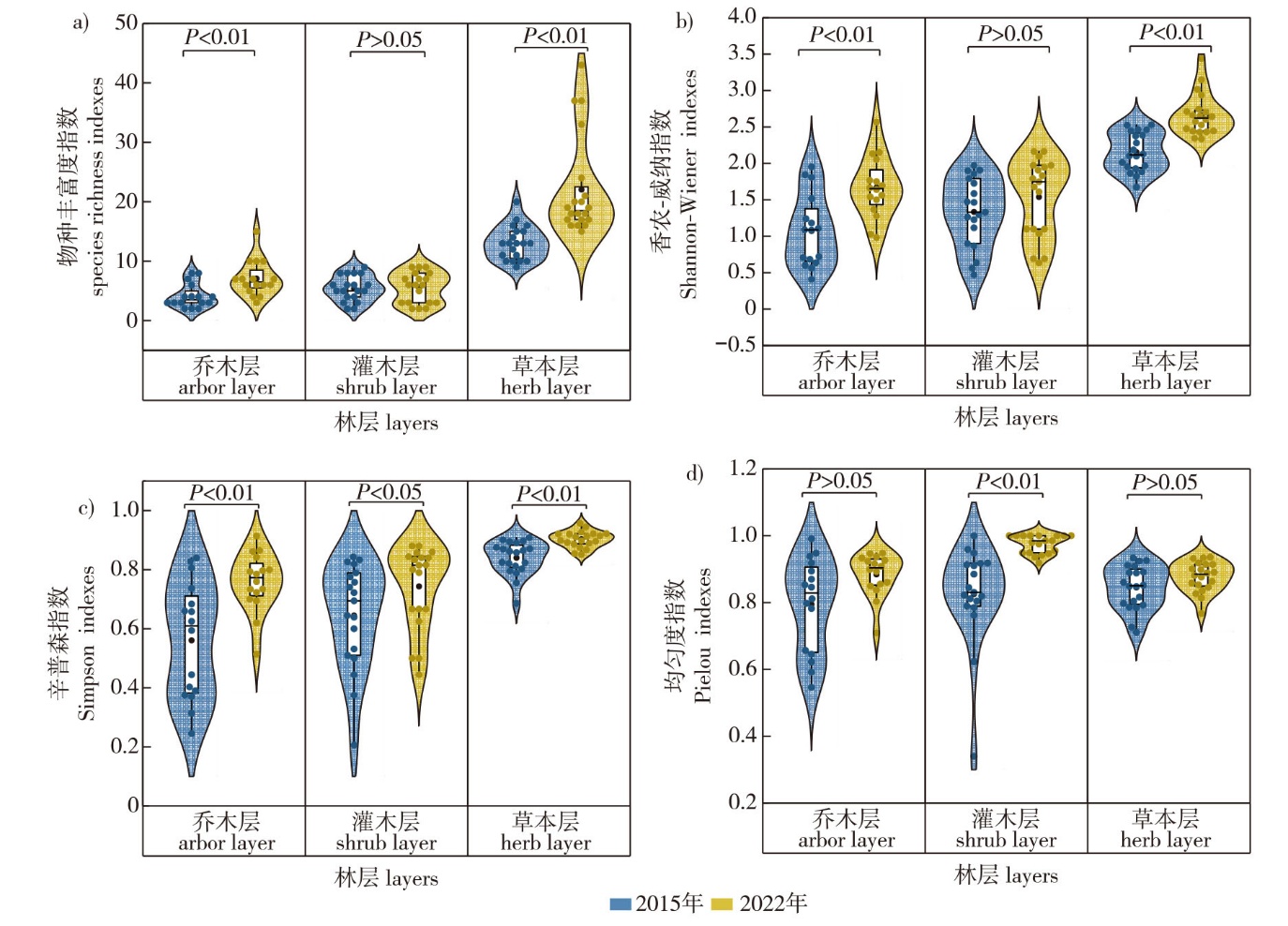
【Objective】This study investigated changes in the community structure and characteristics of Pinus armandi communities at different stages of pest infestation by Dendroctonus armandi in Shennongjia. The aim was to provide strategies for pest control and forest management of P. armandi community, and to establish a scientific basis for biodiversity conservation.【Method】Fixed-plot surveys were conducted in Shennongjia Forest District in 2015 (earlier pestr infestation stage) and 2022 (later pest infestation stage).We investigated the soil environment and plant community, and analyzed changes in soil properties, species composition, importance values, and biodiversity indices.【Result】Compared to the earlier pest infestation stage, the soil environment changed significantly in the late stage of pest infestation: the content of organic matter, total nitrogen, and total phosphorus increased significantly by 159.86%, 96.18% and 54.39%, respectively. However, soil temperature and humidity, litter thickness, pH, and total potassium exhibited no significant changes. Both species composition and richness increased in the community. Vascular plant diversity expanded from 116 species (63 families, 101 genera) to 189 species (74 families, 145 genera). Specifically, the arbor layer increased by 20 species, the shrub layer added 9 species, and the herb layer increased by 55 species. Changes in importance values varied among layers. P. armandi remained the dominant arbor species, but its importance value declined from 42.52% to 24.41%.The species with the highest importance values in the shrub layer changed significantly, whereas the herb layer retained its top three species: Parathelypteris nipponica, Oplismenus undulatifolius and Galium hoffmeisteri. Biodiversity changes also differed among layers. In the arbor and herb layers,species richness, Shannon-Wiener index, and Simpson index increased significant, while the Pielou index showed no marked change. In the shrub layer, Pielou and Simpson indices increased significantly, while richness and Shannon-Wiener index remained stable.【Conclusion】Despite the decline in the P. armandi population due to years of pest infestation, the composition and structure became more complex and biodiversity increased, particularly in arbor and herb layers. In managing P. armandi-infested forests, natural restoration should be prioritized. Species across all layers that exhibit strong environmental adaptability should be protected, and the regeneration layer should be fostered. In addition, strategic gap planting utilizing high-importance-value species—such as Cornus controversa, Carpinus turczaninovii, and Juglans mandshurica—are recommended to enhance biodiversity and promote community stabilization.
Pinus armandi / pest infestation / community structure / biodiversity / importance value / Dendroctonus armandi / Shennongjia, Hubei
| [1] |
丛明旸, 石会平, 张小锟, 等. 八仙山国家级自然保护区典型森林群落结构及物种多样性研究[J]. 南开大学学报(自然科学版), 2013, 46(4):44-52.
|
| [2] |
袁蕾, 周华荣, 宗召磊, 等. 乌鲁木齐地区典型灌木群落结构特征及其多样性研究[J]. 西北植物学报, 2014, 34(3):595-603.
|
| [3] |
|
| [4] |
宋厚娟, 叶吉, 师帅, 等. 长白山区阔叶红松林残留片段木本植物物种组成与群落结构[J]. 应用生态学报, 2014, 25(5):1239-1249.
|
| [5] |
陈泓宇, 兰明钰, 孙传玺, 等. 粤北不同演替阶段森林群落结构与种间关联[J]. 森林与环境学报, 2022, 42(5):465-473.
|
| [6] |
范明阳, 胡萌, 杨园, 等. 中国东部地区马尾松与黄山松群落分类及群落结构和物种多样性特征[J]. 南京林业大学学报(自然科学版), 2024, 48(1):47-58.
|
| [7] |
柏冰洋, 易家喜, 崔娥, 等. 华山松大小蠹的防控技术研究综述[J]. 湖北林业科技, 2023, 52(5):68-72.
|
| [8] |
胡文杰, 崔鸿侠, 潘磊, 等. 神农架国家公园华山松退化群落生态位特征及种间关系[J]. 西南林业大学学报(自然科学), 2023, 43(6):26-37.
|
| [9] |
张子一, 查玉平, 王少明, 等. 神农架林区华山松大小蠹生物学特性研究[J]. 中国森林病虫, 2015, 34(6):1-4.
|
| [10] |
赵明振, 代鲁鲁, 陈辉. 华山松大小蠹野外诱捕探究[J]. 西北林学院学报, 2018, 33(5):137-141,230.
|
| [11] |
王文杰, 杜红居, 肖路, 等. 凉水自然保护区3种森林类型的植物组成和林分结构特征[J]. 林业科学, 2019, 55(9):166-176.
|
| [12] |
黄金莲, 崔鸿侠, 唐万鹏, 等. 虫害对华山松人工林土壤酶活性及碳氮磷化学计量特征的影响[J]. 林业科学, 2023, 59(10):128-137.
|
| [13] |
张亚昊. 基于多源遥感数据的神农架华山松大小蠹虫害空间格局动态变化研究[D]. 武汉: 华中农业大学, 2022.
|
| [14] |
陈文静, 徐华东, 刘美爽. 应用MODIS数据监测神农架林区大小蠹虫害时空分布[J]. 中南林业科技大学学报, 2020, 40(12):60-68.
|
| [15] |
马望, 房磊, 方国飞, 等. 基于最大熵模型的神农架林区华山松大小蠹灾害遥感监测[J]. 生态学杂志, 2016, 35(8):2122-2131.
|
| [16] |
何斌, 李青, 刘勇. 草海国家级自然保护区华山松群落特征及物种多样性研究[J]. 热带亚热带植物学报, 2020, 28(1):44-52.
|
| [17] |
胡文杰, 潘磊, 唐万鹏, 等. 虫害侵扰初期华山松群落草本层生态位特征和种间关系[J]. 东北林业大学学报, 2023, 51(3):36-40.
|
| [18] |
王建栋, 张志华, 杨喜田, 等. 黑河流域土壤理化性质分布特征[J]. 河南农业大学学报, 2020, 54(1):133-139.
|
| [19] |
庾晓红, 李贤伟, 白降丽. 我国植被数量分析方法的研究概况和发展趋势[J]. 生态学杂志, 2005, 24(4):448-451.
|
| [20] |
吴昊. 不同类型群落物种多样性指数的比较研究[J]. 中南林业科技大学学报, 2015, 35(5):84-89.
|
| [21] |
马克平, 刘玉明. 生物群落多样性的测度方法 Ⅰ.α多样性的测度方法(下)[J]. 生物多样性, 1994, 2(4):231-239.
|
| [22] |
范杰. 地形和林分结构对神农架华山松大小蠹发生的影响及不同林分类型下华山松更新特征研究[D]. 武汉: 华中农业大学, 2024.
|
| [23] |
|
| [24] |
|
| [25] |
赵成章, 石福习, 董小刚, 等. 祁连山北坡退化林地植被群落的自然恢复过程及土壤特征变化[J]. 生态学报, 2011, 31(1):115-122.
|
| [26] |
王绍颖. 神农架华山松退化林植物多样性与群落演替趋势研究[D]. 武汉: 华中农业大学, 2023.
|
| [27] |
胡文浩, 张晓婧, 陈雅杰, 等. 坝上地区不同年代退耕还林生境的草本层植物多样性及影响因子[J]. 生态学报, 2021, 41(3):1116-1126.
|
| [28] |
|
| [29] |
王耀仪, 王宏翔, 王永强, 等. 雅长保护区老龄林不同林层功能性状多样性及其影响因素分析[J]. 南京林业大学学报(自然科学版), 2024, 48(5):28-38.
|
| [30] |
|
| [31] |
康永祥, 康博文, 刘建军, 等. 陕北黄土高原文冠果群落结构及物种多样性[J]. 生态学报, 2010, 30(16):4328-4339.
|
| [32] |
冷流江, 张艳, 赵廷宁, 等. 松散堆积体边坡植被分布特征及其环境因子解析[J]. 生态与农村环境学报, 2024, 40(12):1595-1602.
|
| [33] |
胡文杰, 王晓荣, 崔鸿侠, 等. 林分结构和树种组成对宜昌九岭头马尾松林更新幼苗密度的影响[J]. 植物资源与环境学报, 2020, 29(4):52-60.
|
| [34] |
郭弘婷, 纪小芳, 汪成, 等. 我国人工林林下灌木层植物多样性空间变异及影响要素[J]. 南京林业大学学报(自然科学版), 2022, 46(4):144-152.
|
/
| 〈 |
|
〉 |