Effects of long-term nitrogen addition on particulate organic carbon and mineral-associated organic carbon in a poplar plantation

Song Jia, Ruan Honghua, Fang Yu, Liu Huihui, Zhang Chen, Xu Runfeng, Xu Yaming, Shen Caiqin, Cao Guohua

Journal of Nanjing Forestry University (Natural Sciences Edition) ›› 2026, Vol. 50 ›› Issue (4) : 126-135.

PDF(2076 KB)
PDF(2076 KB)
Journal of Nanjing Forestry University (Natural Sciences Edition) ›› 2026, Vol. 50 ›› Issue (4) : 126-135. DOI: 10.12302/j.issn.1000-2006.202503003

Effects of long-term nitrogen addition on particulate organic carbon and mineral-associated organic carbon in a poplar plantation

Author information +
History +

Abstract

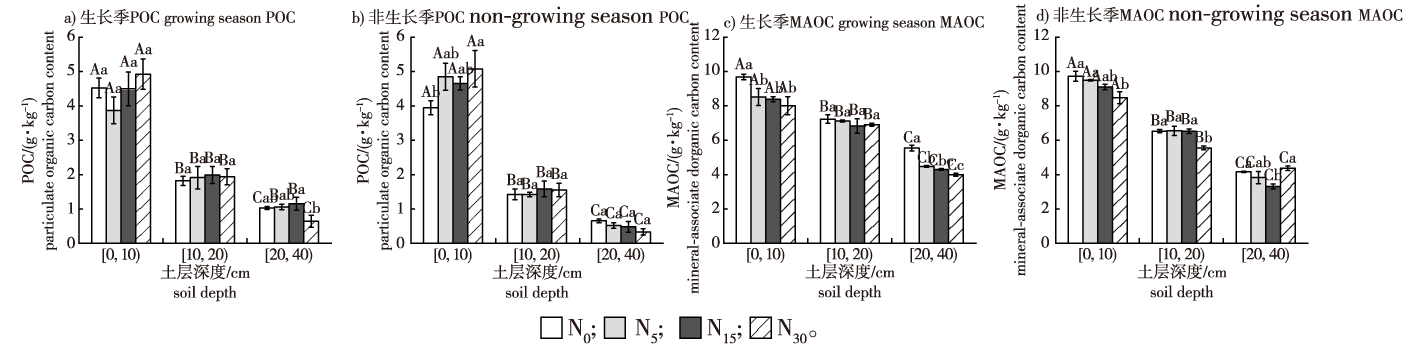
【Objective】The atmospheric nitrogen deposition may significantly alter carbon cycling processes in terrestrial ecosystems. Soil particulate organic carbon (POC) and mineral-associated organic carbon (MAOC) are the main components of SOC. The effect of nitrogen addition on their dynamic changes is critical for understanding and predicting the response and adaptation mechanisms of SOC in plantation forests under long-term nitrogen deposition.【Method】Taking the plantation of Populus deltoides cv. I-35 in the Dongtai Forest Farm, Jiangsu Province, experimental plots were established in May 2012 to simulate atmospheric nitrogen deposition artificially. Four nitrogen application levels were set, i.e. 0 g/(m2·a)(N0), 5 g/(m2·a)(N5),15 g/(m2·a)(N15), and 30 g/(m2· a) (N30). Each nitrogen treatment included four replicated plots, resulting in 16 plots. We collected soil, litter, and fine root samples from each plot at different nitrogen treatments in August 2023 (growing season) and January 2024 (non-growing season), respectively. The soil was analyzed for pH, ammonium nitrogen, nitrate nitrogen, total soil organic carbon, dissolved organic carbon, microbial biomass carbon, and other physicochemical properties, as well as for POC and MAOC fractions. Litter and fine roots were analyzed for total carbon, carbon-to-nitrogen ratio, and biomass. The changes in the concentrations of soil POC and MAOC under different nitrogen addition levels and their driving factors were investigated by two-way ANOVA, correlation and redundancy analysis (RDA).【Result】Nitrogen addition significantly reduced the content of MAOC overall but had no significant effect on the content of soil POC, except in the [0,10) cm (surface) soil during the non-growing season. Moreover, during the growing season, N5, N15, and N30 treatments significantly reduced MAOC content in both surface and [20,40) cm (lower) soil layers. The effects on MAOC content in the middle soil layer were not significant. During the non-growing season, the N15 treatment significantly reduced MAOC content in the lower soil layer, while the N30 treatment significantly reduced MAOC content in the surface and [10,20) cm (middle) soil layers. All nitrogen treatments had no significant effect on POC during the growing season, while the N30 treatment significantly increased the content of POC in the surface layer during the non-growing season. The contents of soil POC and MAOC generally decreased significantly with increasing soil depth. Regarding seasonal variation, the soil POC and MAOC were overall higher in the growing season than in the non-growing season, with significant changes observed in the middle and lower soil layers. Two-way ANOVA indicated that the interaction between nitrogen treatment and soil depth had a highly significant effect on MAOC but no significant effect on POC. Correlation analysis showed that MAOC was positively correlated with total carbon in leaf litter. Both POC and MAOC were significantly positively correlated with total soil organic carbon, dissolved organic carbon, microbial biomass carbon, ammonium nitrogen, soil moisture, and total nitrogen. In contrast, they were negatively correlated with pH, carbon-to-nitrogen ratio, and nitrate nitrogen. Redundancy analysis revealed that POC and MAOC were significantly positively correlated with microbial biomass carbon and total carbon, and significantly negatively correlated with nitrate nitrogen.【Conclusion】The findings of this study demonstrate that long-term nitrogen addition promotes the accumulation of particulate organic carbon (POC) while reducing the accumulation of mineral-associated organic carbon (MAOC). This suggests that prolonged global nitrogen deposition may negatively impact the accumulation and overall stability of soil organic carbon pools, which holds significant implications for the long-term storage of soil carbon in forest ecosystems.
Key words

poplar plantation / nitrogen addition / particulate organic carbon / mineral-associated organic carbon

Cite this article

Download Citations
Song Jia , Ruan Honghua , Fang Yu , et al . Effects of long-term nitrogen addition on particulate organic carbon and mineral-associated organic carbon in a poplar plantation[J]. Journal of Nanjing Forestry University (Natural Sciences Edition). 2026, 50(4): 126-135 https://doi.org/10.12302/j.issn.1000-2006.202503003

References

[1]
Luo Z K, Wang G C, Wang E L. Global subsoil organic carbon turnover times dominantly controlled by soil properties rather than climate[J]. Nature Communications, 2019, 10:3688. DOI:10.1038/s41467-019-11597-9.
[2]
Ning Q S, Hättenschwiler S, X T, et al. Carbon limitation overrides acidification in mediating soil microbial activity to nitrogen enrichment in a temperate grassland[J]. Global Change Biology, 2021, 27(22):5976-5988. DOI:10.1111/gcb.15819.
[3]
Averill C, Waring B. Nitrogen limitation of decomposition and decay:how can it occur?[J]. Global Change Biology, 2018, 24(4):1417-1427. DOI:10.1111/gcb.13980.
[4]
Hemingway J D, Rothman D H, Grant K E, et al. Mineral protection regulates long-term global preservation of natural organic carbon[J]. Nature, 2019, 570(7760):228-231. DOI:10.1038/s41586-019-1280-6.
[5]
张颖, 李晓格, 温亚利. 碳达峰碳中和背景下中国森林碳汇潜力分析研究[J]. 北京林业大学学报, 2022, 44(1):38-47.
Zhang Y, Li X G, Wen Y L. Forest carbon sequestration potential in China under the background of carbon emission peak and carbon neutralization[J]. Journal of Beijing Forestry University, 2022, 44(1):38-47. DOI:10.12171/j.1000?1522.20210143.
[6]
Hong S B, Ding J Z, Kan F, et al. Asymmetry of carbon sequestrations by plant and soil after forestation regulated by soil nitrogen[J]. Nature Communications, 2023, 14:3196. DOI:10.1038/s41467-023-38911-w.
[7]
Yang X M, Ma S H, Huang E H, et al. Nitrogen addition promotes soil carbon accumulation globally[J]. Science China Life Sciences, 2025, 68(1):284-293. DOI:10.1007/s11427-024-2752-2.
[8]
Chen J G, Xiao W, Zheng C Y, et al. Nitrogen addition has contrasting effects on particulate and mineral-associated soil organic carbon in a subtropical forest[J]. Soil Biology and Biochemistry, 2020, 142:107708. DOI:10.1016/j.soilbio.2020.107708.
[9]
Lu X F, Hou E Q, Guo J Y, et al. Nitrogen addition stimulates soil aggregation and enhances carbon storage in terrestrial ecosystems of China:a meta-analysis[J]. Global Change Biology, 2021, 27(12):2780-2792. DOI:10.1111/gcb.15604.
[10]
闫宇鹏, 张博涵, 周志东, 等. 氮添加对我国喀斯特农田和森林生态系统土壤有机碳及其组分影响的Meta分析[J]. 环境科学, 2024, 45(9):5406-5415.
Yan Y P, Zhang B H, Zhou Z D, et al. Effects of nitrogen addition on soil organic carbon and its fractions in Karst farmland and forest ecosystems of China based on meta-analysis[J]. Environmental Science, 2024, 45(9):5406-5415. DOI:10.13227/j.hjkx.202309091.
[11]
Tang B, Rocci K S, Lehmann A, et al. Nitrogen increases soil organic carbon accrual and alters its functionality[J]. Global Change Biology, 2023, 29(7):1971-1983. DOI:10.1111/gcb.16588.
[12]
Rocci K S, Lavallee J M, Stewart C E, et al. Soil organic carbon response to global environmental change depends on its distribution between mineral-associated and particulate organic matter:a meta-analysis[J]. Science of the Total Environment, 2021, 793:148569. DOI:10.1016/j.scitotenv.2021.148569.
[13]
Amundson R, Biardeau L. Soil carbon sequestration is an elusive climate mitigation tool[J]. Proceedings of the National Academy of Sciences of the United States of America, 2018, 115(46):11652-11656. DOI:10.1073/pnas.1815901115.
[14]
李晓宇, 杨成超, 彭建东. 杨树人工林地力衰退研究现状与进展[J]. 辽宁林业科技, 2011(6):39-42.
Li X Y, Yang C C, Peng J D. Research status and progress of soil fertility decline in poplar plantations[J]. Liaoning Forestry Science and Technology, 2011(6):39-42.
[15]
谢涛, 王明慧, 郑阿宝, 等. 苏北沿海不同林龄杨树林土壤活性有机碳特征[J]. 生态学杂志, 2012, 31(1):51-58.
Xie T, Wang M H, Zheng A B, et al. Characteristics of soil labile organic carbon in poplar plantations of different ages in coastal area of North Jiangsu[J]. Chinese Journal of Ecology, 2012, 31(1):51-58. DOI:10.13292/j.1000-4890.2012.0004.
[16]
涂利华, 胡庭兴, 张健, 等. 模拟氮沉降对华西雨屏区苦竹林土壤有机碳和养分的影响[J]. 植物生态学报, 2011, 35(2):125-136.
Tu L H, Hu T X, Zhang J, et al. Response of soil organic carbon and nutrients to simulated nitrogen deposition in Pleioblastus amarus plantation,rainy area of west China[J]. Chinese Journal of Plant Ecology, 2011, 35(2):125-136. DOI:10.3773/j.issn.1005-264x.2009.04.011.
[17]
王梓萌, 阮宏华, 吴小巧, 等. 模拟氮沉降对杨树人工林土壤跳虫群落的影响[J]. 南京林业大学学报(自然科学版), 2024, 48(4):243-253.
Wang Z M, Ruan H H, Wu X Q, et al. Effects of nitrogen addition on soil springtail(Collembolan) community in a poplar plantation[J]. Journal of Nanjing Forestry University (Natural Sciences Edition), 2024, 48(4):243-253.
[18]
Ghani A, Dexter M, Perrott K W. Hot-water extractable carbon in soils:a sensitive measurement for determining impacts of fertilisation,grazing and cultivation[J]. Soil Biology and Biochemistry, 2003, 35(9):1231-1243. DOI:10.1016/S0038-0717(03)00186-X.
[19]
Wu J, Joergensen R G, Pommerening B, et al. Measurement of soil microbial biomass C by fumigation-extraction:an automated procedure[J]. Soil Biology and Biochemistry, 1990, 22(8):1167-1169. DOI:10.1016/0038-0717(90)90046-3.
[20]
李佩聪. 环境水体中基于邻苯基苯酚-靛酚蓝分光光度法的铵氮测定新方法的研究和应用[D]. 厦门: 厦门大学, 2019.
Li P C. Study and application of the indophenol method for the determination of ammonium in natural waters using O-phenylphenol[D]. Xiamen: Xiamen University, 2019.
[21]
GB 17378.4—2007 海洋监测规范第4部分:海水分析[S].
[22]
LY/T 1237—1999 森林土壤有机质的测定及碳氮比的计算[S].
[23]
Shi K, Liao J H, Zou X M, et al. Accumulation of soil microbial extracellular and cellular residues during forest rewilding:implications for soil carbon stabilization in older plantations[J]. Soil Biology and Biochemistry, 2024, 188:109250. DOI:10.1016/j.soilbio.2023.109250.
[24]
鲁如坤. 土壤农业化学分析方法[M]. 北京: 中国农业科学技术出版社, 2000.
Lu R K. Methods of soil agrochemical analysis[M].China Agricultural Science and Technology Press, 2000.
[25]
Song B, Niu S L, Li L H, et al. Soil carbon fractions in grasslands respond differently to various levels of nitrogen enrichments[J]. Plant and Soil, 2014, 384(1):401-412. DOI:10.1007/s11104-014-2219-1.
[26]
Riggs C E, Hobbie S E, Bach E M, et al. Nitrogen addition changes grassland soil organic matter decomposition[J]. Biogeochemistry, 2015, 125(2):203-219. DOI:10.1007/s10533-015-0123-2.
[27]
Soong J L, Fuchslueger L, Marañon-Jimenez S, et al. Microbial carbon limitation:the need for integrating microorganisms into our understanding of ecosystem carbon cycling[J]. Global Change Biology, 2020, 26(4):1953-1961. DOI:10.1111/gcb.14962.
[28]
Sinsabaugh R L, Manzoni S, Moorhead D L, et al. Carbon use efficiency of microbial communities:stoichiometry,methodology and modelling[J]. Ecology Letters, 2013, 16(7):930-939. DOI:10.1111/ele.12113.
[29]
Lajtha K, Townsend K L, Kramer M G, et al. Changes to particulate versus mineral-associated soil carbon after 50 years of litter manipulation in forest and prairie experimental ecosystems[J]. Biogeochemistry, 2014, 119(1):341-360. DOI:10.1007/s10533-014-9970-5.
[30]
Zhang L, Liu J, Xi J Z, et al. Competition for nitrogen between plants and microorganisms in grasslands:effect of nitrogen application rate and plant acquisition strategy[J]. Biology and Fertility of Soils, 2024, 60(2):227-236. DOI:10.1007/s00374-023-01782-w.
[31]
朱教君, 高添, 于立忠, 等. 森林生态系统碳汇:概念、时间效应与提升途径[J]. 应用生态学报, 2024, 35(9):2313-2321.
Zhu J J, Gao T, Yu L Z, et al. Carbon sink of forest ecosystems:concept,time effect and improvement approaches[J]. Chinese Journal of Applied Ecology, 2024, 35(9):2313-2321. DOI:10.13287/j.1001-9332.202409.025.
[32]
Meng X T, Zhang X C, Li Y N, et al. Nitrogen fertilizer builds soil organic carbon under straw return mainly via microbial necromass formation[J]. Soil Biology and Biochemistry, 2024, 188:109223. DOI:10.1016/j.soilbio.2023.109223.
[33]
Guan Z H, Jia B, Niu Z Q, et al. Humidity controls soil organic carbon accrual in grassland on the Qinghai-Tibet Plateau[J]. Soil Biology and Biochemistry, 2025, 201:109655. DOI:10.1016/j.soilbio.2024.109655.
[34]
Hu Y L, Ao G, Feng J G, et al. The patterns of forest soil particulate and mineral associated organic carbon characteristics with latitude and soil depth across Eastern China[J]. Forest Ecosystems, 2025, 12:100291. DOI:10.1016/j.fecs.2024.100291.
[35]
Song B, Niu S L, Zhang Z, et al. Light and heavy fractions of soil organic matter in response to climate warming and increased precipitation in a temperate steppe[J]. PLoS One, 2012, 7(3):e33217. DOI:10.1371/journal.pone.0033217.
[36]
Cusack D F, Silver W L, Torn M S, et al. Effects of nitrogen additions on above-and belowground carbon dynamics in two tropical forests[J]. Biogeochemistry, 2011, 104(1):203-225. DOI:10.1007/s10533-010-9496-4.
[37]
Duan P P, Wang K L, Li D J. Nitrogen addition effects on soil mineral-associated carbon differ between the valley and slope in a subtropical karst forest[J]. Geoderma, 2023, 430:116357. DOI:10.1016/j.geoderma.2023.116357.
[38]
Zhang Y X, Tang Z X, You Y M, et al. Differential effects of forest-floor litter and roots on soil organic carbon formation in a temperate oak forest[J]. Soil Biology and Biochemistry, 2023, 180:109017. DOI:10.1016/j.soilbio.2023.109017.
[39]
仲琦, 李曾燕, 马炜, 等. 氮添加和凋落物处理对华西雨屏区常绿阔叶林凋落叶分解的影响[J]. 植物生态学报, 2023, 47(5):629-643.
Zhong Q, Li Z Y, Ma W, et al. Effects of nitrogen addition and litter manipulations on leaf litter decomposition in western edge of Sichuan Basin,China[J]. Chinese Journal of Plant Ecology, 2023, 47(5):629-643. DOI:10.17521/cjpe.2022.0063.
[40]
段娜, 李清河, 多普增, 等. 植物响应大气氮沉降研究进展[J]. 世界林业研究, 2019, 32(4):6-11.
Duan N, Li Q H, Duo P Z, et al. Plant response to atmospheric nitrogen deposition:a research review[J]. World Forestry Research, 2019, 32(4):6-11. DOI:10.13348/j.cnki.sjlyyj.2019.0029.y.
[41]
Song W, Hu C S, Luo Y, et al. Nitrate as an alternative electron acceptor destabilizes the mineral associated organic carbon in moisturized deep soil depths[J]. Frontiers in Microbiology, 2023, 14:1120466. DOI:10.3389/fmicb.2023.1120466.
[42]
Ren T T, Yu X Y, Liao J H, et al. Application of biogas slurry rather than biochar increases soil microbial functional gene signal intensity and diversity in a poplar plantation[J]. Soil Biology and Biochemistry, 2020, 146:107825. DOI:10.1016/j.soilbio.2020.107825.
PDF(2076 KB)

Accesses

Citation

Detail

Sections
Recommended
The full text is translated into English by AI, aiming to facilitate reading and comprehension. The core content is subject to the explanation in Chinese.

/