PDF(3264 KB)

Drought resistance and water replenishment effect of the Three Gorges Reservoir on the middle-lower reaches of the Yangtze River
Huang Wei, Zhang Xingnan, Li Ruonan, Xiang Xiaohua, Wu Biqiong, Yu Zhongyu, Zhang Zengxin
Journal of Nanjing Forestry University (Natural Sciences Edition) ›› 2026, Vol. 50 ›› Issue (4) : 234-244.
PDF(3264 KB)
 PDF(3264 KB)
Drought resistance and water replenishment effect of the Three Gorges Reservoir on the middle-lower reaches of the Yangtze River
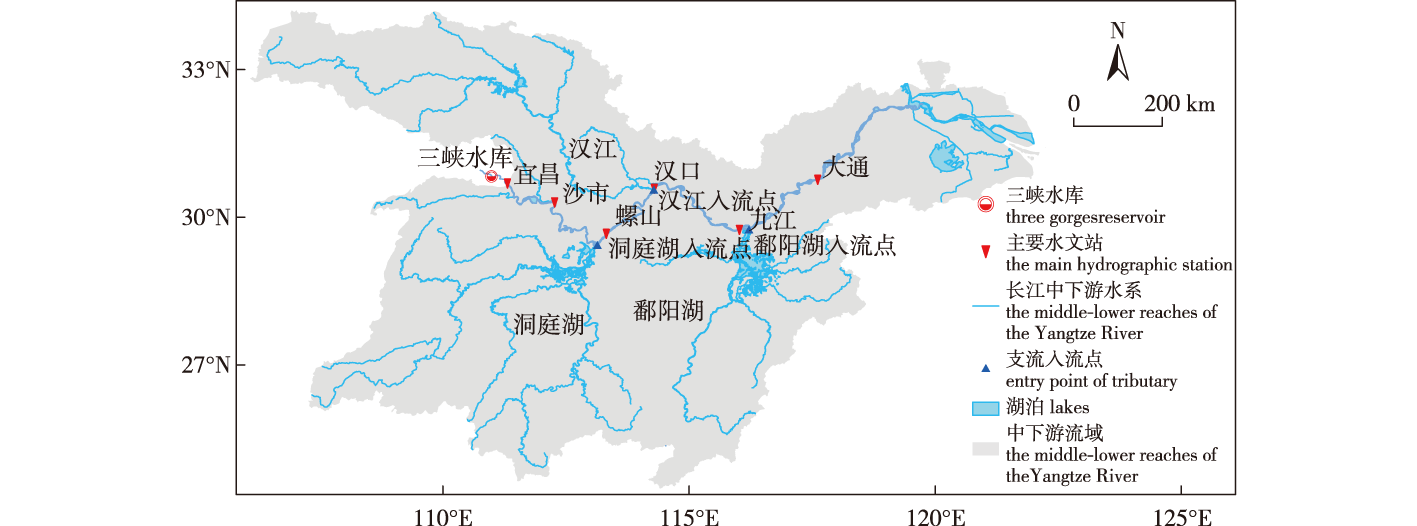
【Objective】While the Three Gorges Reservoir (TGR) plays a crucial role in mitigating extreme droughts in the middle and lower Yangtze River basin, quantitative assessments of its drought-relief water supplementation effects remain insufficient. This study aims to quantitatively analyze the regulatory effects of the Three Gorges Reservoir’s water supplementation on water levels and discharge in the mainstem of the middle and lower reaches, providing theoretical basis for scientific evaluation of drought mitigation benefits.【Method】Utilizing daily water level and discharge data from the TGR and the middle-lower Yangtze River between 2020 and 2022, a one-dimensional hydrodynamic model was employed to analyze the water replenishment effects of the TGR on the downstream reaches.【Result】(1)Model validation confirmed high simulation accuracy for all study sections, demonstrating its reliability for drought mitigation studies. (2) Water supplementation analysis revealed that maximum water level increases in the Shashi-Hankou reach, with progressive downstream attenuation. When the TGR maintained a discharge of 5 000 m3/s with a supplementation flow of 3 000 m3/s, the Shashi station showed increases of 2 018 m3/s in discharge and 1.03 m in water level. These effects decreased to 895 m3/s and 0.40 m at Hankou station, further declined to 645 m3/s and 0.34 m, 536 m3/s and 0.16 m at Jiujiang and Datong stations, respectively. (3) During August and September 2022, two drought-relief water supplementation operations released 830 million m3 and 680 million m3 of water, respectively. The Shashi-Hankou reach benefited substantially: in the second operation, Shashi station received a cumulative supplementation of 642 million m3, delaying water cutoff at Shishou waterworks by 6 days, while Luoshan station received 574 million m3, postponing Panwan waterworks’ cutoff by 5 days. Downstream of Hankou, flow augmentation predominated, with Datong station accumulating 300 million to 400 million m3 of supplemented water, crucial for maintaining its 10 000 m3/s minimum ecological flow threshold.【Conclusion】The drought-mitigation water supplementation operations from the TGR significantly alleviated drought conditions in the middle and lower reaches. We propose implementing differentiated regulation strategies. water-level-oriented regulation for the Shashi-Hankou reach, and discharge-focused control for downstream sections (with particular emphasis on maintaining the minimum ecological flow threshold of 10 000 m3/s at Datong station). These strategies should be complemented by section-specific water supplementation schemes tailored to the temporal water demand variations at different cross-sections, thereby optimizing the overall ecological benefits of water supplementation.
Three Gorges Reservoir / middle-lower Yangtze River / drought event over Yangtze River basin in 2022 / hydrodynamic model / water level regulation / ecological water replenishment benefit
| [1] |
熊斌, 卓云强, 许崇育, 等. 1956—2022年鄱阳湖枯水情势演变及驱动机制分析[J]. 水利学报, 2024, 55(3):313-324.
|
| [2] |
|
| [3] |
|
| [4] |
|
| [5] |
许全喜, 董炳江, 袁晶, 等. 三峡工程运用后长江中下游河道冲刷特征及其影响[J]. 湖泊科学, 2023, 35(2):650-661.
|
| [6] |
许继军, 陈进, 常福宣. 控制性水利工程对长江中下游水资源影响与对策[J]. 人民长江, 2014, 45(7):11-17,76.
|
| [7] |
|
| [8] |
张继顺, 张雅琪, 张慧. 三峡水库应对大旱的运用方式研究[C]// 中国水力发电工程学会梯级调度控制专业委员会2011年年会论文集. 成都,2011:53-64.
|
| [9] |
彭利鸿, 周建中, 黄竟择, 等. 适应电网需求的三峡水库汛期洪水资源利用研究[J]. 水电能源科学, 2021, 39(8):76-80.
|
| [10] |
赖锡军, 姜加虎, 黄群. 三峡对长江中下游干流汛末水位影响:2006—2011年实例模拟[J]. 长江流域资源与环境, 2014, 23(4):475-481.
|
| [11] |
李宁宁. 基于风险分摊的梯级水库汛期水位动态控制及决策研究[D]. 北京: 华北电力大学, 2021.
|
| [12] |
李响, 郭生练, 李雨. 三峡水库汛期水位实时动态控制研究[C]// 水利水电工程风险分析及可靠度设计方法研讨会论文集. 宜昌,2010:202-207.
|
| [13] |
李肖男, 傅巧萍, 张松, 等. 三峡水库汛期运行水位运用方式研究[J]. 人民长江, 2022, 53(2):21-26,40.
|
| [14] |
李博远, 骆进军, 闫永銮. 《水利部水旱灾害防御应急响应工作规程》解读:访水利部水旱灾害防御司司长姚文广[J]. 中国水利, 2022(11):16-19,15.
|
| [15] |
李真. 三峡水库新增抗旱功能[N]. 中国水利报,2010-01-29(1).
|
| [16] |
曹瑞, 李帅, 龚文婷, 等. 金沙江下游-三峡梯级水库2023年联合调度实践[J]. 人民长江, 2024, 55(6):1-8.
|
| [17] |
荆平飞, 李肖男, 郭率, 等. 2022年特枯水年三峡水库补水调度策略研究[J]. 人民长江, 2024, 55(9):51-59.
|
| [18] |
柯帅, 丁兵, 渠庚. 枯水情势对长江中下游取水工程运行影响及对策研究[J]. 中国防汛抗旱, 2023, 33(9):25-30.
|
| [19] |
郑静, 张虎. 2022年长江流域水库群抗旱补水调度实践与思考[J]. 人民长江, 2023, 54(2):7-11,42.
|
| [20] |
黄艳, 李荣波, 马立亚, 等. 长江流域2022年抗旱管理实践与思考[J]. 中国防汛抗旱, 2023, 33(3):1-11,29.
|
| [21] |
丁胜祥, 张俊, 牛文静, 等. 应对2022年枯水的长江上游水库群联合调度方案[J]. 人民长江, 2023, 54(2):1-6.
|
| [22] |
李英海, 姜庆琛, 王永强, 等. 三峡水库应急抗旱补水调度对下游水位的影响及效益评估[J]. 水力发电学报, 2024, 43(12):64-76.
|
| [23] |
田乐琪. 一维水动力学模型MIKE11模拟研究[D]. 天津: 天津工业大学, 2020.
|
| [24] |
戴明龙. 长江上游巨型水库群运行对流域水文情势影响研究[D]. 武汉: 华中科技大学, 2017.
|
| [25] |
邹橙, 杨景文, 刘攀, 等. 基于一维水动力模型的利泽航电枢纽生态调度研究[J]. 中国农村水利水电, 2024(12):170-176.
|
| [26] |
|
| [27] |
|
| [28] |
|
| [29] |
|
| [30] |
|
| [31] |
张学宏, 李颜, 郝培章, 等. 水文资料插值计算方法探讨[J]. 海洋预报, 2008, 25(1):5-13.
|
| [32] |
|
| [33] |
|
| [34] |
仲华. 基于MIKE11的河东泵站引排规模论证及排涝调度方案优选[D]. 扬州: 扬州大学, 2023.
|
| [35] |
吴长春, 王中雅. 水力分析与计算[M]. 北京: 中国水利水电出版社, 2023.
|
| [36] |
|
| [37] |
|
| [38] |
马宗伟, 许有鹏, 钟善锦. 水系分形特征对流域径流特性的影响:以赣江中上游流域为例[J]. 长江流域资源与环境, 2009, 18(2):163-169.
|
| [39] |
|
| [40] |
|
| [41] |
|
| [42] |
李清清. 适应多维度用水需求的水库群供水调度技术[M]. 北京: 中国水利水电出版社, 2020.
|
| [43] |
许银山, 曾明, 裘诚, 等. 2022年长江口压咸补淡调度实践及成效[J]. 人民长江, 2023, 54(8):40-45.
|
| [44] |
王超, 王福良, 李浩, 等. 涉河工程影响下长江中游河道演变及水力特性变化研究[J]. 水利水电快报, 2023, 44(2):48-54.
|
/
| 〈 |
|
〉 |