PDF(2831 KB)

Understory species composition and phylogenetic diversity during subtropical evergreen broad-leaved forest restoration
Wu Binfei, Xiao Keqin, Hu Zhanpeng, Ge Zhiwei, Miao Zimei
Journal of Nanjing Forestry University (Natural Sciences Edition) ›› 2026, Vol. 50 ›› Issue (5) : 189-198.
PDF(2831 KB)
 PDF(2831 KB)
Understory species composition and phylogenetic diversity during subtropical evergreen broad-leaved forest restoration
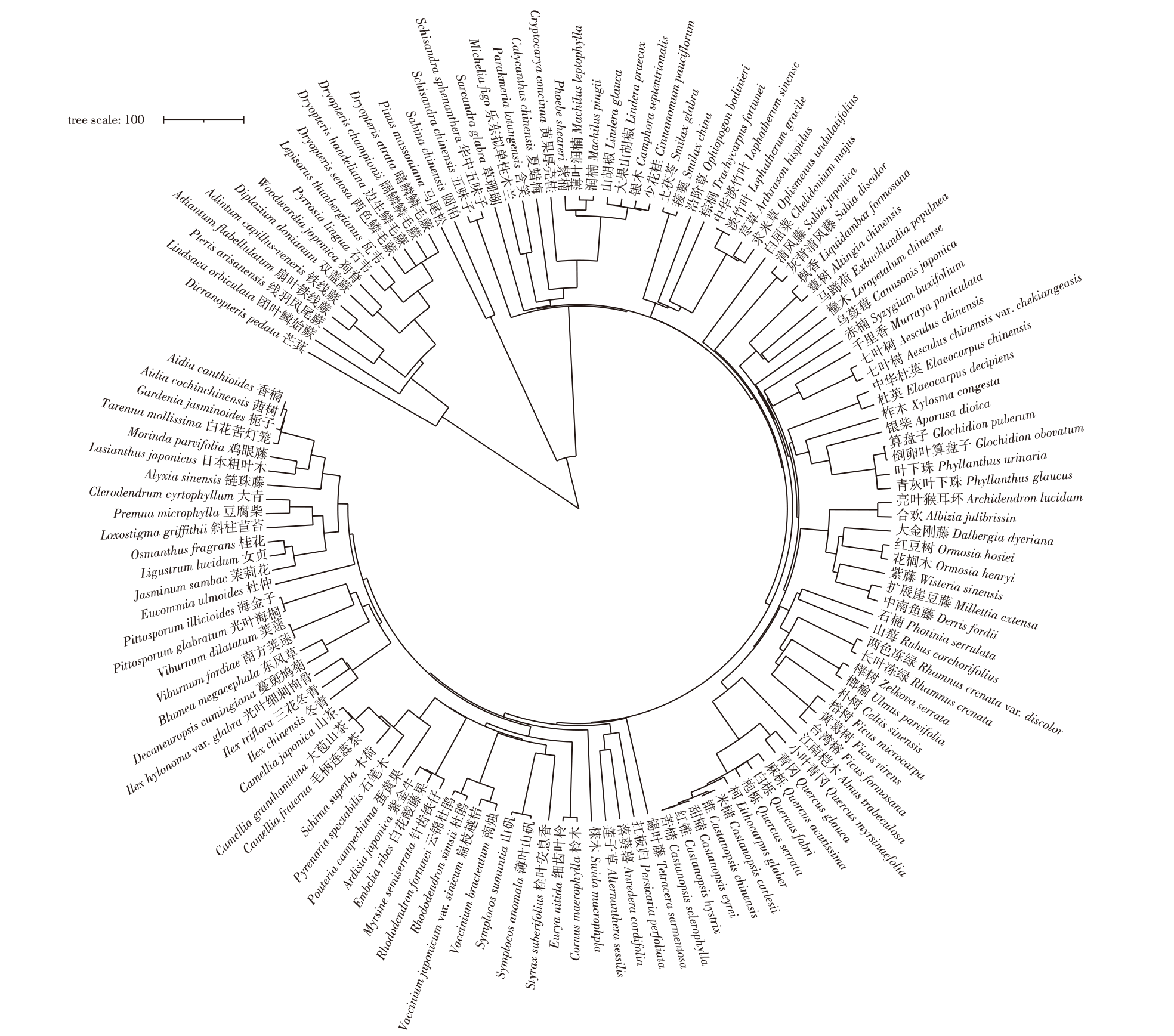
【Objective】This study compared species composition and phylogenetic diversity between naturally restored (30-year) secondary forests and primary forests in Huangyanshan. It analyzed differences in understory community reassembly mechanisms. 【Method】The investigation employed a plot-based survey method collecting tree, shrub, and herb community data. Calculations determined species diversity indices and phylogenetic diversity indices. Analysis assessed trends in these indices and the influence of soil factors.This approach revealed ecological 82 species, while natural forests had 48 families, 71 genera, and 96 species. Natural forests showed significantly higher tree layer species evenness than secondary forests(P<0.05). Shrub and herb layers exhibited significant differences in phylogenetic diversity indices between forest types (P<0.01). Tree and shrub layers displayed clustered phylogenetic structures (nearest relatedness index(NRI)>0, nearest taxon index (NTI)>0) in both forests. Herb layers generally maintained over dispersed structures (NRI<0, NTI<0). Soil total phosphorus drove variations in species diversity and phylogenetic structure across all understory layers in secondary forests (P<0.05). Available soil potassium and organic matter significantly influenced these patterns in natural forests (P<0.05). 【Conclusion】Tree layer assembly favored stochastic dispersal during secondary forest restoration, while environmental filtering dominated in primary forests. Abiotic environmental filtering governed shrub layer dynamics across both forest types. Herb layer assembly primarily resulted from competitive exclusion. Managers should prioritize enhancing phosphorus availability in initial secondary forest recovery. Primary forest management must focus on maintaining topsoil organic matter turnover and nutrient cycling processes.
subtropical evergreen broad-leaved forest / species diversity / phylogenetic structure / community assembly mechanisms / soil environmental factors
| [1] |
|
| [2] |
刘子琪, 姚良锦, 焦洁洁, 等. 亚热带次生常绿阔叶林植物功能性状及多样性对人工抚育的响应[J]. 生态学报, 2024, 44(11):4733-4743.
|
| [3] |
柴永福. 森林演替过程中的群落构建和植物资源获取策略[C]// 陕西省植物学会. 陕西省植物学会2024年学术研讨会摘要集. 2024:14-15.
|
| [4] |
|
| [5] |
牛克昌, 刘怿宁, 沈泽昊, 等. 群落构建的中性理论和生态位理论[J]. 生物多样性, 2009, 17(6):579-593.
|
| [6] |
|
| [7] |
陈海辉, 黄海, 田乐宇, 等. 自然恢复下马占相思人工林植被群落特征变化[J]. 南方农业学报, 2024, 55(9):2721-2733.
|
| [8] |
马克平. 生物群落多样性的测度方法:Ⅰα多样性的测度方法(上)[J]. 生物多样性, 1994, 2(3):162-168.
|
| [9] |
赵珂萱. 内蒙古高原和青藏高原荒漠生态系统植物多样性格局及驱动力[D]. 呼和浩特: 内蒙古大学, 2023.
|
| [10] |
郭超, 王东男, 张硕, 等. 林下植被对胡桃楸人工林细根生物量和形态特征的影响[J]. 中南林业科技大学学报, 2025, 45(1):82-89,101.
|
| [11] |
鲁旭东, 董禹然, 李垚, 等. 中国亚热带杉木人工林不同林分发育阶段的群落构建机制[J]. 南京林业大学学报(自然科学版), 2024, 48(1):67-73.
|
| [12] |
|
| [13] |
冯刚. 古田山亚热带天然林和次生林群落系统发育结构和功能结构的初步研究[D]. 北京: 中国科学院大学, 2012.
|
| [14] |
|
| [15] |
李建, 李晓宇, 曹静, 等. 长白山次生针阔混交林群落结构特征及群落动态[J]. 生态学报, 2020, 40(4):1195-1206.
|
| [16] |
霍雪莹. 秦岭两种典型次生林群落构建及其稳定性研究[D]. 杨凌: 西北农林科技大学, 2024.
|
| [17] |
李玉滢, 陈向向, 应益山, 等. 浙江省龙游县野猪种群密度和活动节律研究[J]. 浙江农林大学学报, 2024, 41(6):1142-1149.
|
| [18] |
浙江省龙游县志编纂委员会. 龙游县志[M]. 北京: 中华书局, 1991.
|
| [19] |
LY/T 1239-1999森林土壤pH值的测定[S].
|
| [20] |
LY/T 1237-1999森林土壤有机质的测定及碳氮比的计算[S].
|
| [21] |
LY/T 1228-2015森林土壤氮的测定[S].
|
| [22] |
LY/T 1232-2015森林土壤磷的测定[S].
|
| [23] |
LY/T 1234-2015森林土壤钾的测定[S].
|
| [24] |
|
| [25] |
|
| [26] |
|
| [27] |
|
| [28] |
吕自立, 刘彬, 常凤, 等. 巴音布鲁克高寒草甸物种多样性与系统发育多样性沿海拔梯度分布格局及驱动因子[J]. 草业学报, 2023, 32(7):12-22.
|
| [29] |
李梦佳, 何中声, 江蓝, 等. 戴云山物种多样性与系统发育多样性海拔梯度分布格局及驱动因子[J]. 生态学报, 2021, 41(3):1148-1157.
|
| [30] |
何中声, 陈佳嘉, 朱静, 等. 戴云山南坡不同海拔森林土壤微生物功能多样性特征及影响因素[J]. 生态学报, 2022, 42(9):3504-3515.
|
| [31] |
|
| [32] |
|
| [33] |
司彬, 姚小华, 任华东, 等. 桂西喀斯特植被恢复演替过程中物种多样性变化[J]. 西南大学学报(自然科学版), 2008, 30(3):113-118.
|
| [34] |
黄庆荣, 施逸啸, 江蓝, 等. 格氏栲天然林植物功能性状与系统发育对林窗大小的响应[J]. 森林与环境学报, 2023, 43(5):449-456.
|
| [35] |
李宸钟, 李淑静, 王新杰. 格氏栲天然林群落结构特征及多样性分析[J]. 西北林学院学报, 2023, 38(4):44-50.
|
| [36] |
付靖媛, 张谦, 苏文华. 元江锥群落垂直结构的构建机制初探[J]. 广西植物, 2022, 42(6):1040-1048.
|
| [37] |
郑维艳, 曾文豪, 唐一思, 等. 中国大陆北热带及亚热带地区樟科、壳斗科物种多样性及其生物地理格局分析[J]. 生态学报, 2018, 38(24):8676-8687.
|
| [38] |
陈博, 江蓝, 谢子扬, 等. 格氏栲天然林林窗植物物种多样性与系统发育多样性[J]. 生物多样性, 2021, 29(4):439-448.
|
| [39] |
杨志汝, 张建鹏. 秦岭太白山巴山冷杉天然林群落物种多样性[J]. 西北林学院学报, 2023, 38(2):140-146,192.
|
| [40] |
李婧怡, 陈晓霞, 李梦玮, 等. 川西亚高山森林不同恢复途径物种组成和群落结构动态变化[J]. 生态学报, 2024, 44(8): 3471-3482.
|
| [41] |
湛斌. 紫金山两种林型灌木层植被功能性状和系统发育多样性[D]. 南京林业大学, 2018.
|
| [42] |
曾晓敏, 高金涛, 范跃新, 等. 中亚热带森林转换对土壤磷积累的影响[J]. 生态学报, 2018, 38(13):4879-4887.
|
| [43] |
赵亮, 杨治春, 周卷华, 等. 秦岭北麓典型栓皮栎天然次生林群落结构与物种组成[J]. 应用生态学报, 2023, 34(12):3214-3222.
|
| [44] |
刘爱平, 王小红, 孙杰, 等. 湿润亚热带森林类型转换对土壤有机碳矿化的影响及其非生物调控因素[J]. 应用生态学报, 2025, 36(5):1371-1379.
|
| [45] |
陈会玲, 勾蒙蒙, 刘常富, 等. 鄂中丘陵区不同林龄马尾松人工林林下植物多样性与土壤理化性质关系[J]. 生态环境学报, 2024, 33(10):1525-1533.
|
/
| 〈 |
|
〉 |