PDF(2205 KB)

The short-term effects of pruning and water-nitrogen regulation on the growth of Populus tomentosa and the distribution of available nitrogen in deep soil
Wang Yafei, Zhu Wei, Qu Guanbo, Ding Xiaofei, Xu Kexin, Jia Liming
Journal of Nanjing Forestry University (Natural Sciences Edition) ›› 2026, Vol. 50 ›› Issue (4) : 155-164.
PDF(2205 KB)
 PDF(2205 KB)
The short-term effects of pruning and water-nitrogen regulation on the growth of Populus tomentosa and the distribution of available nitrogen in deep soil
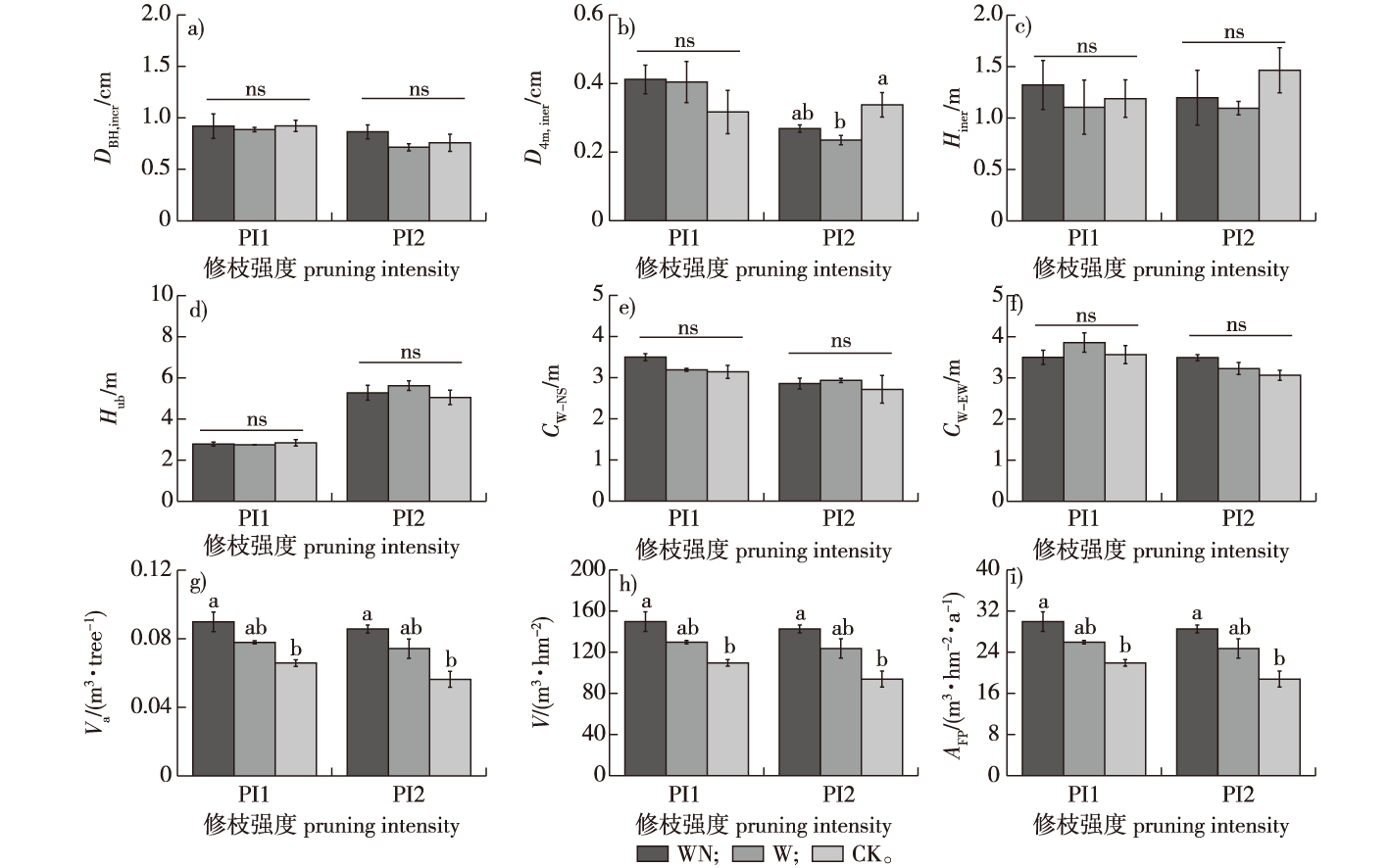
【Objective】This study aims to clarify the response of Populus tomentosa forest growth and deep soil available nitrogen to pruning and water-nitrogen regulation, and provide theoretical reference for the optimization of efficient structural control technology for fast-growing tree species.【Method】Taking 5-year-old triploid poplar S86 in the Yellow River floodplain as the research object, a drip irrigation water-nitrogen coupling experiment was set up under different pruning intensities. By monitoring the growth characteristics of forest trees and the distribution of available nitrogen in the soil at [0,600)cm, the short-term effects of pruning and water-nitrogen regulation on the growth of P. tomentosa and the distribution of available nitrogen in deep soil were revealed.【Result】(1) Water and nitrogen additions had a significant impact on the individual tree volume, forest volume and annual forest productivity of P. tomentosa at the end of the growing season, but pruning and interaction did not play a significant regulatory role. Under non-pruning and pruning conditions, the annual forest productivity of the irrigated nitrogen treatment was significantly increased by 36.51% and 51.94% compared with the no fertilization or irrigation(CK)treatment. (2) From May to August, the relative growth rate (RGR) of the diameter at breast height of P. tomentosa under each treatment decreased month by month, and the diameter at breast height of the forest trees showed a “fast-slow” growth trend. Neither fertilization nor irrigation changed the growth rhythm of P. tomentosa, but pruning had a significant negative regulatory effect on the cumulative increase in diameter at breast height and RGR. (3) Pruning and pruning-water-nitrogen interaction effects have not affected the soil available nitrogen content in the [0,600)cm layer, but the addition of nitrogen fertilizer can increase the soil available nitrogen, especially in the [0,100)cm and [100,200)cm soil layers. The distribution of available nitrogen has both “surface aggregation” and “deep aggregation”.【Conclusion】The addition of water and nitrogen after pruning of P. tomentosa can inhibit the negative effects of pruning, promote the individual size development of forest trees and increase annual forest productivity, and at the same time supplement the available nitrogen content of forest soil. This study aims to provide a theoretical reference for the sustainable management of unknotted and large-diameter timber of P. tomentosa.
Populus tomentosa / pruning / water-nitrogen regulation / forest tree growth / deep soil available nitrogen
| [1] |
曲冠博, 贾黎明. 结构调控对人工用材林生长及生理生态过程影响研究进展[J]. 世界林业研究, 2023, 36(4):28-34.
|
| [2] |
|
| [3] |
方升佐, 徐锡增, 严相进, 等. 修枝强度和季节对杨树人工林生长的影响[J]. 南京林业大学学报, 2000, 24(6):6-10.
|
| [4] |
李广德, 张亚雄, 时海香, 等. 修枝对8年生三倍体毛白杨生长及生理的短期影响[J]. 中南林业科技大学学报, 2018, 38(2):30-35.
|
| [5] |
|
| [6] |
尚富华, 李吉跃, 胡磊, 等. 修枝对毛白杨无性系生长、净光合速率和蒸腾速率的影响[J]. 中国农学通报, 2010, 26(23):134-139.
|
| [7] |
|
| [8] |
|
| [9] |
王亚飞, 贺曰林, 杨红青, 等. 灌溉施肥对杨树人工林林木及地力效应研究进展[J]. 世界林业研究, 2023, 36(5):63-69.
|
| [10] |
|
| [11] |
|
| [12] |
|
| [13] |
董雯怡, 聂立水, 李吉跃, 等. 应用15N示踪研究毛白杨苗木对不同形态氮素的吸收及分配[J]. 北京林业大学学报, 2009, 31(4):97-101.
|
| [14] |
常笑超, 刘勇, 李进宇, 等. 不同形态氮素配比对雄性毛白杨苗木生长的影响[J]. 北京林业大学学报, 2018, 40(9):63-71.
|
| [15] |
|
| [16] |
|
| [17] |
万长园, 王明玉, 王慧芳, 等. 华北平原典型剖面地下水三氮污染时空分布特征[J]. 地球与环境, 2014, 42(4):472-479.
|
| [18] |
贺曰林, 王烨, 张宏锦, 等. 地表滴灌水氮耦合对毛白杨幼林生长及土壤水氮分布的影响[J]. 农业工程学报, 2018, 34(20):90-98.
|
| [19] |
|
| [20] |
戴腾飞, 席本野, 闫小莉, 等. 施肥方式和施氮量对欧美108杨人工林土壤氮素垂向运移的影响[J]. 应用生态学报, 2015, 26(6):1641-1648.
|
| [21] |
张润哲, 朱嘉磊, 王江, 等. 长期施氮与灌溉对毛白杨人工林土壤硝态氮分布与积累的影响[J]. 林业科学研究, 2019, 32(6):7-13.
|
| [22] |
方升佐. 中国杨树人工林培育技术研究进展[J]. 应用生态学报, 2008, 19(10):2308-2316.
|
| [23] |
朱嘉磊, 薄慧娟, 李璇, 等. 不同毛白杨无性系林分蓄积量的长期水氮耦合效应[J]. 林业科学, 2019, 55(5):27-35.
|
| [24] |
|
| [25] |
|
| [26] |
于景麟, 刘峰, 贺曰林, 等. 沟灌水氮耦合对毛白杨林木生长及水氮吸收利用的影响[J]. 应用生态学报, 2020, 31(7):2314-2322.
|
| [27] |
张亚雄. 三倍体毛白杨人工林林木分枝特点与修枝短期响应[D]. 北京: 北京林业大学, 2017.
|
| [28] |
|
| [29] |
王烨. 毛白杨速生纸浆林地下滴灌施肥效应研究[D]. 北京: 北京林业大学, 2015.
|
| [30] |
陈章水. 杨树二元立木材积表的编制[J]. 林业科学研究, 1989, 2(1):78-83.
|
| [31] |
马兴华, 于振文, 梁晓芳, 等. 施氮量和底施追施比例对土壤硝态氮和铵态氮含量时空变化的影响[J]. 应用生态学报, 2006, 17(4):4630-4634.
|
| [32] |
王亚飞, 杨红青, 周欧, 等. 水氮耦合下高密度毛白杨纸浆林树木各器官化学计量特征[J]. 北京林业大学学报, 2023, 45(12):68-79.
|
| [33] |
于景麟. 沟灌水肥耦合三倍体毛白杨水氮吸收及利用研究[D]. 北京: 北京林业大学, 2020.
|
| [34] |
贾黎明, 邢长山, 韦艳葵, 等. 地下滴灌条件下杨树速生丰产林生长与光合特性[J]. 林业科学, 2004, 40(2):61-67.
|
| [35] |
杨康, 徐晓萱, 孙海龙, 等. 修枝强度对水曲柳人工林生长和干形的影响[J]. 东北林业大学学报, 2024, 52(11):10-16.
|
| [36] |
|
| [37] |
|
| [38] |
陈森锟. 欧美107杨对修枝抚育的生长与生理响应研究[D]. 北京: 北京林业大学, 2008.
|
| [39] |
|
| [40] |
|
| [41] |
|
| [42] |
王烨, 李广德, 刘国彬, 等. 毛白杨人工林物候特征和生长对施肥的可塑性响应[J]. 林业科学, 2023, 59(5):32-40.
|
| [43] |
席本野, 王烨, 邸楠, 等. 地下滴灌下土壤水势对毛白杨纸浆林生长及生理特性的影响[J]. 生态学报, 2012, 32(17):5318-5329.
|
| [44] |
|
| [45] |
贺曰林. 毛白杨S86人工林根区滴灌施肥及水氮调控机制研究[D]. 北京: 北京林业大学, 2021.
|
| [46] |
苏波, 韩兴国, 渠春梅, 等. 森林土壤氮素可利用性的影响因素研究综述[J]. 生态学杂志, 2002, 21(2):40-46.
|
| [47] |
商放泽, 杨培岭, 李云开, 等. 不同施氮水平对深层包气带土壤氮素淋溶累积的影响[J]. 农业工程学报, 2012, 28(7):103-110.
|
| [48] |
黄梦遥, 张润哲, 史策, 等. 不同施氮量和灌水水平下毛白杨林地土壤矿质氮动态[J]. 林业科学, 2023, 59(9):45-54.
|
| [49] |
|
| [50] |
|
| [51] |
|
/
| 〈 |
|
〉 |