Spatiotemporal dynamics analysis of canopy water potential in Pinus elliottii using UAV-based multispectral and LiDAR fusion

Guo Shunliang, Niu Xiaoyun, Peng Yeqing, Li Yanjie

Journal of Nanjing Forestry University (Natural Sciences Edition) ›› 2026, Vol. 50 ›› Issue (4) : 105-114.

PDF(17695 KB)
PDF(17695 KB)
Journal of Nanjing Forestry University (Natural Sciences Edition) ›› 2026, Vol. 50 ›› Issue (4) : 105-114. DOI: 10.12302/j.issn.1000-2006.202507022

Spatiotemporal dynamics analysis of canopy water potential in Pinus elliottii using UAV-based multispectral and LiDAR fusion

Author information +
History +

Abstract

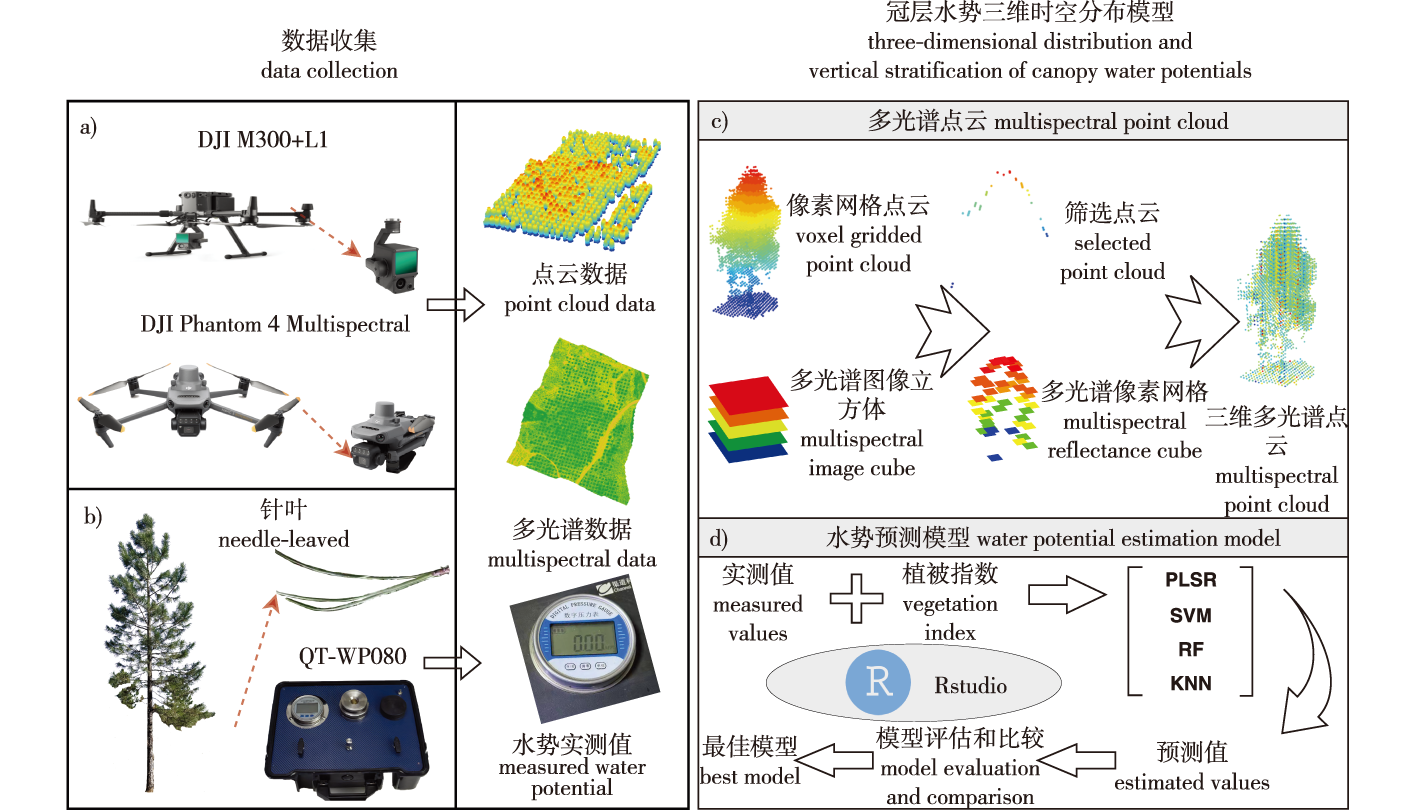
【Objective】This study investigates the three-dimensional canopy water potential of Pinus elliottii (slash pine) to systematically analyze its intra-annual variations and vertical dynamics, providing theoretical support for drought resistance research and precision forestry management.【Method】From December 2023 to November 2024, we collected monthly canopy remote sensing data in a slash pine seed orchard in Xuancheng City, Anhui Province, using the fusion technology of UAV multispectral and LiDAR data. Three-dimensional multispectral point clouds were reconstructed, and a random forest (RF) model was applied to predict canopy water potential. On this basis, we investigated the monthly dynamics and vertical canopy gradients of slash pine canopy water potential, and compared the monthly differences in canopy water potential among 20 open-pollinated families.【Result】The RF model achieved the optimal prediction accuracy, with an R2 of 0.88 for the training dataset and 0.70 for the test dataset. The canopy water potential of slash pine exhibits significant seasonal fluctuations. Higher values were observed in March, April and July 2024, while the minimum values occurred in May and November. Vertically, canopy water potential follows a vertical gradient characterized by lower values in the upper canopy and higher values in the lower canopy. Significant differences in canopy water potential were detected among families. Families 1, 2, 14 consistently ranked higher in canopy water potential across most months.【Conclusion】This study realized three-dimensional remote sensing monitoring of canopy water potential in slash pine for the first time. It systematically revealed the spatiotemporal dynamics of canopy water potential and phenotypic differences among families. The findings provide novel theoretical foundations and practical references for drought resistance research and precision forestry management.
Key words

Pinus elliottii (slash pine) / canopy water potential / UAV remote sensing / multispectral and LiDAR fusion / family divergence

Cite this article

Download Citations
Guo Shunliang , Niu Xiaoyun , Peng Yeqing , et al. Spatiotemporal dynamics analysis of canopy water potential in Pinus elliottii using UAV-based multispectral and LiDAR fusion[J]. Journal of Nanjing Forestry University (Natural Sciences Edition). 2026, 50(4): 105-114 https://doi.org/10.12302/j.issn.1000-2006.202507022

References

[1]
Chen S N, Chen Z, Kong Z, et al. The increase of leaf water potential and whole-tree hydraulic conductance promotes canopy conductance and transpiration of Pinus tabulaeformis during soil droughts[J]. Trees, 2023, 37(1):41-52. DOI:10.1007/s00468-022-02322-z.
[2]
Anderegg L D L, HilleRisLambers J. Drought stress limits the geographic ranges of two tree species via different physiological mechanisms[J]. Global Change Biology, 2016, 22(3):1029-1045. DOI:10.1111/gcb.13148.
[3]
俞满源, 黄占斌, 山仑. 不同水分条件下CO2浓度升高对植物生长及水分利用效率的影响[J]. 中国生态农业学报, 2003, 11(3):110-112.
Yu M Y, Huang Z B, Shan L. Response of plant growth and water use efficiency to different water contents under environmental CO2 concentration raising[J]. Chinese Journal of Eco-Agriculture, 2003, 11(3):110-112.
[4]
胡继超, 姜东, 曹卫星, 等. 短期干旱对水稻叶水势、光合作用及干物质分配的影响[J]. 应用生态学报, 2004, 15(1):63-67.
Hu J C, Jiang D, Cao W X, et al. Effect of short-term drought on leaf water potential,photosynthesis and dry matter partitioning in paddy rice[J]. Chinese Journal of Applied Ecology, 2004, 15(1):63-67. DOI:10.13287/j.1001-9332.2004.0014.
[5]
贺玉晓, 赵丽, 魏雅丽, 等. 水分胁迫下柱花草叶水势、光合及叶绿素荧光特性的变化特征[J]. 农业环境科学学报, 2012, 31(10):1897-1905.
He Y X, Zhao L, Wei Y L, et al. Variation characteristics of leaf water potential,photosynthesis and chlorophyll fluorescence in Stylosanthes guianensis leaves under soil water stress[J]. Journal of Agro-Environment Science, 2012, 31(10):1897-1905.
[6]
Meiri A, Plaut Z, Shimshi D. The use of the pressure chamber technique for measurement of the water potential of transpiring plant organs[J]. Physiologia Plantarum, 1975, 35(1):72-76. DOI:10.1111/j.1399-3054.1975.tb03870.x.
[7]
Tsuda M, Tyree M T. Plant hydraulic conductance measured by the high pressure flow meter in crop plants[J]. Journal of Experimental Botany, 2000, 51(345):823-828.
[8]
BANSOD B, SINGH R, THAKUR R, et al. A comparision between satellite based and drone based remote sensing technology to achieve sustainable development: a review[J]. Journal of Agriculture and Environment for International Development (JAEID). 2017, 111(2): 383-407.
[9]
Cheng J P, Yang H, Qi J B, et al. Estimating canopy-scale chlorophyll content in apple orchards using a 3D radiative transfer model and UAV multispectral imagery[J]. Computers and Electronics in Agriculture, 2022, 202:107401. DOI:10.1016/j.compag.2022.107401.
[10]
Karpina M, Jarzabek-Rychard M, Tymków P, et al. UAV-based automatic tree growth measurement for biomass estimation[J]. International Archives of the Photogrammetry,Remote Sensing and Spatial Information Sciences,2016,XLI-B8:685-688. DOI:10.5194/isprsarchives-xli-b8-685-2016.
[11]
Duarte A, Borralho N, Cabral P, et al. Recent advances in forest insect pests and diseases monitoring using UAV-based data:a systematic review[J]. Forests, 2022, 13(6):911. DOI:10.3390/f13060911.
[12]
Chisholm R A, Cui J Q, Lum S K Y, et al. UAV LiDAR for below-canopy forest surveys[J]. Journal of Unmanned Vehicle Systems, 2013, 1(1):61-68. DOI:10.1139/juvs-2013-0017.
[13]
Ecke S, Dempewolf J, Frey J, et al. UAV-based forest health monitoring:a systematic review[J]. Remote Sensing, 2022, 14(13):3205. DOI:10.3390/rs14133205.
[14]
Zhang L Y, Zhang H H, Niu Y X, et al. Mapping maize water stress based on UAV multispectral remote sensing[J]. Remote Sensing, 2019, 11(6):605. DOI:10.3390/rs11060605.
[15]
Shen X, Cao L, Coops N C, et al. Quantifying vertical profiles of biochemical traits for forest plantation species using advanced remote sensing approaches[J]. Remote Sensing of Environment, 2020, 250:112041. DOI:10.1016/j.rse.2020.112041.
[16]
Melgani F, Bruzzone L. Classification of hyperspectral remote sensing images with support vector machines[J]. IEEE Transactions on Geoscience and Remote Sensing, 2004, 42(8):1778-1790. DOI:10.1109/TGRS.2004.831865.
[17]
Shen L Z, Gao M F, Yan J W, et al. Hyperspectral estimation of soil organic matter content using different spectral preprocessing techniques and PLSR method[J]. Remote Sensing, 2020, 12(7):1206. DOI:10.3390/rs12071206.
[18]
Meng Q M, Cieszewski C J, Madden M, et al. K nearest neighbor method for forest inventory using remote sensing data[J]. GIScience & Remote Sensing, 2007, 44(2):149-165. DOI:10.2747/1548-1603.44.2.149.
[19]
刘海娟, 张婷, 侍昊, 等. 基于RF模型的高分辨率遥感影像分类评价[J]. 南京林业大学学报(自然科学版), 2015, 39(1):99-103.
Liu H J, Zhang T, Shi H, et al. Classification evaluation on high resolution remote sensing image based on RF[J]. Journal of Nanjing Forestry University (Natural Sciences Edition), 2015, 39(1):99-103. DOI:10.3969/j.issn.1000-2006.2015.01.001.
[20]
Akar Ö, Güngör O. Classification of multispectral images using Random Forest algorithm[J]. Journal of Geodesy and Geoinformation, 2012, 1(2):105-112. DOI:10.9733/jgg.241212.1.
[21]
Liang L, Di L P, Huang T, et al. Estimation of leaf nitrogen content in wheat using new hyperspectral indices and a random forest regression algorithm[J]. Remote Sensing, 2018, 10(12):1940. DOI:10.3390/rs10121940.
[22]
Sangeetha T, Lavanya G, Jeyabharathi D, et al. Detection of pest and disease in banana leaf using convolution Random Forest[J]. Test Engineering and Management. 2020, 83: 3727-35.
[23]
Tosin R, Pôcas I, Novo H, et al. Assessing predawn leaf water potential based on hyperspectral data and pigment’s concentration of Vitis vinifera L.in the Douro Wine region[J].Scientia Horticulturae, 2021, 278:109860. DOI:10.1016/j.scienta.2020.109860.
[24]
周日巍, 郭亚男, 龚伟, 等. 不同施肥量对湿地松松脂产量的影响[J]. 特种经济动植物, 2024, 27(11):43-45,74.
Zhou R W, Guo Y N, Gong W, et al. Effects of different fertilization rates on rosin yield of Pinus elliottii[J]. Special Economic Animals and Plants, 2024, 27(11):43-45,74.
[25]
Collins A B. Density and height growth in natural slash pine[M]. Asheville: U.S. Department of Agriculture, Forest Service, Southeastern Forest Experiment Station, 1967.
[26]
Tao X Y, Li Y J, Yan W Q, et al. Heritable variation in tree growth and needle vegetation indices of slash pine (Pinus elliottii) using unmanned aerial vehicles (UAVs)[J]. Industrial Crops and Products, 2021, 173:114073. DOI:10.1016/j.indcrop.2021.114073.
[27]
de Oliveira Junkes C F, de Araújo A T Jr, de Lima J C, et al. Resin tapping transcriptome in adult slash pine (Pinus elliottii var. elliottii)[J]. Industrial Crops and Products, 2019, 139:111545. DOI:10.1016/j.indcrop.2019.111545.
[28]
Tang N, Fang Y J, Xiong Z L. Measurement of water potential in plant tissues[J]. Bio-Protocol, 2018: e1010158-e.
[29]
Wang Y X, Yang Z L, Ahmad Khan H, et al. Improving radiometric block adjustment for UAV multispectral imagery under variable illumination conditions[J]. Remote Sensing, 2024, 16(16):3019. DOI:10.3390/rs16163019.
[30]
Huang S, Tang L N, Hupy J P, et al. A commentary review on the use of normalized difference vegetation index (NDVI) in the era of popular remote sensing[J]. Journal of Forestry Research, 2021, 32(1):1155. DOI:10.1007/s11676-020-01155-1.
[31]
Goodwin A W, Lindsey L E, Harrison S K, et al. Estimating wheat yield with normalized difference vegetation index and fractional green canopy cover[J]. Crop,Forage & Turfgrass Management, 2018, 4(1):180026. DOI:10.2134/cftm2018.04.0026.
[32]
Huete A R. A soil-adjusted vegetation index (SAVI)[J]. Remote Sensing of Environment, 1988, 25(3):295-309. DOI:10.1016/0034-4257(88)90106-X.
[33]
Rondeaux G, Steven M, Baret F. Optimization of soil-adjusted vegetation indices[J]. Remote Sensing of Environment, 1996, 55(2):95-107. DOI:10.1016/0034-4257(95)00186-7.
[34]
Hunt E R Jr, Daughtry C S T, Eitel J U H, et al. Remote sensing leaf chlorophyll content using a visible band index[J]. Agronomy Journal, 2011, 103(4):1090-1099. DOI:10.2134/agronj2010.0395.
[35]
Yin G F, Verger A, Descals A, et al. A broadband green-red vegetation index for monitoring gross primary production phenology[J]. Journal of Remote Sensing, 2022,2022:2022/9764982. DOI:10.34133/2022/9764982.
[36]
Qi J, Chehbouni A, Huete A R, et al. A modified soil adjusted vegetation index[J]. Remote Sensing of Environment, 1994, 48(2):119-126. DOI:10.1016/0034-4257(94)90134-1.
[37]
Wu C Y, Niu Z, Gao S. The potential of the satellite derived green chlorophyll index for estimating midday light use efficiency in maize,coniferous forest and grassland[J]. Ecological Indicators, 2012, 14(1):66-73. DOI:10.1016/j.ecolind.2011.08.018.
[38]
Xie Q Y, Dash J, Huang W J, et al. Vegetation indices combining the red and red-edge spectral information for leaf area index retrieval[J]. IEEE Journal of Selected Topics in Applied Earth Observations and Remote Sensing, 2018, 11(5):1482-1493. DOI:10.1109/JSTARS.2018.2813281.
[39]
Guo Y H, Wang H X, Wu Z F, et al. Modified red blue vegetation index for chlorophyll estimation and yield prediction of maize from visible images captured by UAV[J]. Sensors, 2020, 20(18):5055. DOI:10.3390/s20185055.
[40]
Barbosa B D S, Ferraz G A S, Goncalves L M, et al. RGB vegetation indices applied to grass monitoring: a qualitative analysis[J]. Agronomy Research, 2019, 17(2): 349-357.
[41]
Thompson C N, Guo W X, Sharma B, et al. Using normalized difference red edge index to assess maturity in cotton[J]. Crop Science, 2019, 59(5):2167-2177. DOI:10.2135/cropsci2019.04.0227.
[42]
Desaine I, Bāders E, Romāns E, et al. The detection of disturbance effects of Norway spruce (Picea abies (L.) Karst.) in UAV multispectral imagery[J]. ISPRS Annals of the Photogrammetry,Remote Sensing and Spatial Information Sciences,2022,V-3-2022:689-695. DOI:10.5194/isprs-annals-v-3-2022-689-2022.
[43]
Qin J L, Rundquist D, Gitelson A, et al. A non-linear model of nondestructive estimation of anthocyanin content in grapevine leaves with visible/red-infrared hyperspectral[M]// Computer and Computing Technologies in Agriculture IV.Berlin, Heidelberg:Springer,2011:47-62. DOI:10.1007/978-3-642-18369-0_6.
[44]
Cai S S, Zhang W M, Liang X L, et al. Filtering airborne LiDAR data through complementary cloth simulation and progressive TIN densification filters[J]. Remote Sensing, 2019, 11(9):1037. DOI:10.3390/rs11091037.
[45]
Huang Y P. Triangular irregular network generation and topographical modeling[J]. Computers in Industry, 1989, 12(3):203-213. DOI:10.1016/0166-3615(89)90067-5.
[46]
Xu X J, Zhou Z S, Tang Y, et al. Individual tree crown detection from high spatial resolution imagery using a revised local maximum filtering[J]. Remote Sensing of Environment, 2021, 258:112397. DOI:10.1016/j.rse.2021.112397.
[47]
Gu Y Y, Wang Y Q, Wu Y P, et al. Novel 3D photosynthetic traits derived from the fusion of UAV LiDAR point cloud and multispectral imagery in wheat[J]. Remote Sensing of Environment, 2024, 311:114244. DOI:10.1016/j.rse.2024.114244.
[48]
曾琪, 余坤勇, 姚雄, 等. 基于PROSAIL辐射传输模型的毛竹林分冠层反射率模拟研究[J]. 植物科学学报, 2017, 35(5):699-707.
Zeng Q, Yu K Y, Yao X, et al. Research on canopy reflectance modeling of Phyllostachys pubescens forest based on the PROSAIL canopy radiative transfer model[J]. Plant Science Journal, 2017, 35(5):699-707.
[49]
姬永杰, 杨丛瑞, 张王菲, 等. 基于机载P波段全极化SAR数据的森林地上生物量估测[J]. 浙江农林大学学报, 2022, 39(5):971-980.
Ji Y J, Yang C R, Zhang W F, et al. Forest above ground biomass estimation using airborne P band polarimetric SAR data[J]. Journal of Zhejiang A & F University, 2022, 39(5):971-980. DOI:10.11833/j.issn.2095-0756.20220111.
[50]
Noh H, Zhang Q, Shin B, et al. A neural network model of maize crop nitrogen stress assessment for a multi-spectral imaging sensor[J]. Biosystems Engineering, 2006, 94(4):477-485. DOI:10.1016/j.biosystemseng.2006.04.009.
[51]
Wang F, Zhang F, Gou X H, et al. Seasonal variations in leaf-level photosynthesis and water use efficiency of three isohydric to anisohydric conifers on the Tibetan Plateau[J]. Agricultural and Forest Meteorology, 2021, 308:108581. DOI:10.1016/j.agrformet.2021.108581.
[52]
Wankmüller F J P, Carminati A. Stomatal regulation prevents plants from critical water potentials during drought:result of a model linking soil-plant hydraulics to abscisic acid dynamics[J]. Ecohydrology, 2022, 15(5):e2386. DOI:10.1002/eco.2386.
[53]
胡天宇, 刘小强, 吴晓永, 等. 森林冠层结构复杂性研究进展及展望[J]. 遥感学报, 2025, 29(1):83-101.
Hu T Y, Liu X Q, Wu X Y, et al. Advance in forest canopy structural complexity research[J]. National Remote Sensing Bulletin, 2025, 29(1):83-101.
[54]
Fernández-de-Uña L, Martínez-Vilalta J, Poyatos R, et al. The role of height-driven constraints and compensations on tree vulnerability to drought[J]. New Phytologist, 2023, 239(6):2083-2098. DOI:10.1111/nph.19130.
[55]
Li S B, Huang X Y, Zheng R P, et al. Xylem plasticity of root,stem,and branch in Cunninghamia lanceolata under drought stress:implications for whole-plant hydraulic integrity[J]. Frontiers in Plant Science, 2024, 15:1308360. DOI:10.3389/fpls.2024.1308360.
PDF(17695 KB)

Accesses

Citation

Detail

Sections
Recommended
The full text is translated into English by AI, aiming to facilitate reading and comprehension. The core content is subject to the explanation in Chinese.

/