PDF(1520 KB)

Characteristics of forest carbon sinks and management implications in the context of carbon neutrality
WANG Yixiang
Journal of Nanjing Forestry University (Natural Sciences Edition) ›› 2026, Vol. 50 ›› Issue (2) : 1-8.
PDF(1520 KB)
 PDF(1520 KB)
Characteristics of forest carbon sinks and management implications in the context of carbon neutrality
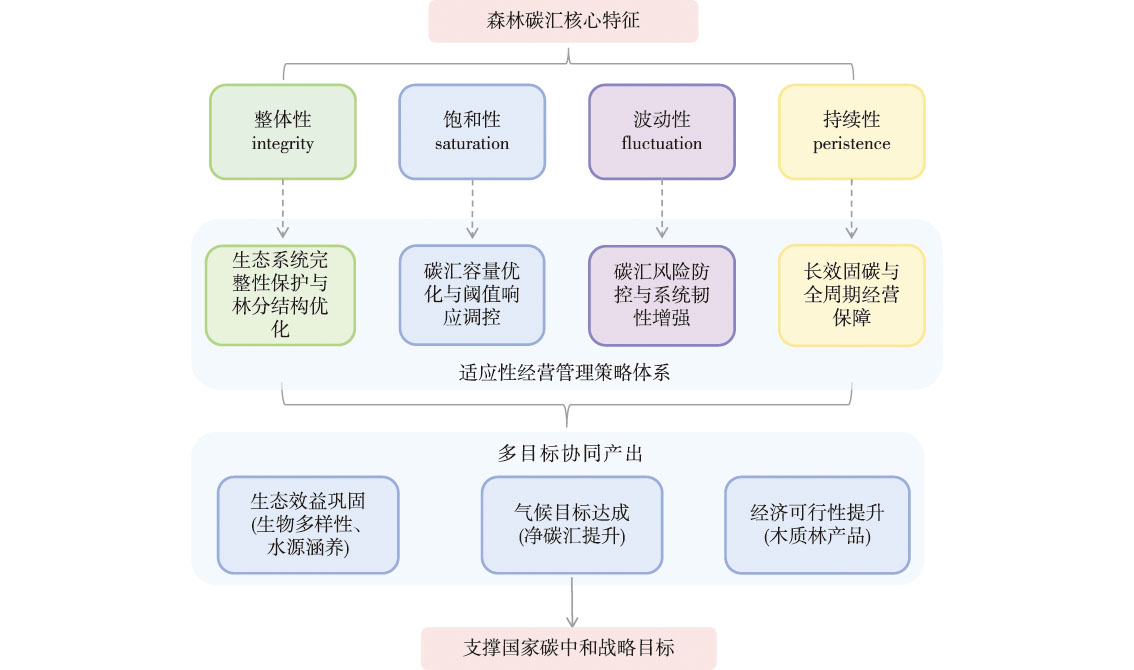
Motivated by the strategic goals of carbon peak and carbon neutrality, the carbon sink function of forest ecosystems has been transitioned from a conventional ecological service to a cornerstone of national climate governance. However, an adaptive forest management system capable of effectively addressing climate change challenge remains under developed. To tackle widespread cognitive misconceptions and practical challenges in forest carbon sink management, this study introduces a framework defining four core characteristics of forest carbon sinks: integrity, saturation, fluctuation and persistence. This framework clarifies the key ecological mechanisms that constrain forest carbon sink functionality. Specifically, integrity reveals the profound reliance of forest carbon sinks on ecosystem integrity; saturation characterizes the physical capacity limits of both biotic and abiotic carbon pools; fluctuation highlights the high sensitivity and risks of carbon sink stability under various disturbances; and persistence defines the critical time scale for which carbon sequestration must be maintained to align with carbon neutrality targets. Based on this framework, the study constructs a comprehensive adaptive forest management strategy system. Key strategies include: (1) conserving ecosystem the integrity and optimizing stand structures; (2) enhancing carbon sink capacity and threshold-based response regulation; (3) preventing carbon sink risks and strengthening system resilience; (4) safeguarding the long-term carbon sequestration through the full-cycle management. Our findings emphasize the urgent need to develop precision regulation technologies that address these inherent carbon sink constraints. Such a technological advances are essential for enhancing the stability and effectiveness of forest carbon sinks in supporting the carbon neutrality process.
carbon neutrality / forest management / carbon sink / ecosystem / carbon pool
| [1] |
方精云, 于贵瑞, 任小波, 等. 中国陆地生态系统固碳效应:中国科学院战略性先导科技专项“应对气候变化的碳收支认证及相关问题”之生态系统固碳任务群研究进展[J]. 中国科学院院刊, 2015, 30(6):848-857,875.
|
| [2] |
《第四次气候变化国家评估报告》编写委员会. 第四次气候变化国家评估报告[M]. 北京: 科学出版社, 2022.
|
| [3] |
董丝雨, 庞革平. 我国森林覆盖率已超过25% 成为全球增绿最多的国家[EB/OL]. 人民日报, 2024-11-25. [2025-08-30]. https://www.peopleapp.com/column/30047474457-500005946335.
|
| [4] |
王秋凤, 刘颖慧, 何念鹏, 等. 中国区域陆地生态系统碳收支综合研究的科技需求与重要科学问题[J]. 地理科学进展, 2012, 31(1):78-87.
|
| [5] |
朴世龙, 岳超, 丁金枝, 等. 试论陆地生态系统碳汇在“碳中和”目标中的作用[J]. 中国科学:地球科学, 2022, 52(7):1419-1426.
|
| [6] |
刘世荣, 王晖, 李海奎, 等. 碳中和目标下中国森林碳储量、碳汇变化预估与潜力提升途径[J]. 林业科学, 2024, 60(4):157-172.
|
| [7] |
|
| [8] |
|
| [9] |
|
| [10] |
王锴, 朴世龙, 何悦, 等. 中国陆地生态系统碳汇稳定性的空间分布特征及驱动机制[J]. 中国科学:地球科学, 2023, 53(2):216-226.
|
| [11] |
|
| [12] |
|
| [13] |
|
| [14] |
|
| [15] |
|
| [16] |
|
| [17] |
|
| [18] |
|
| [19] |
|
| [20] |
|
| [21] |
|
| [22] |
|
| [23] |
|
| [24] |
|
| [25] |
|
| [26] |
IPCC. Global warming of 1.5 ℃: an IPCC special report[R]. Geneva,Switzerland: Intergovernmental Panel on Climate Change, 2018.
|
| [27] |
|
| [28] |
|
| [29] |
|
| [30] |
|
| [31] |
|
| [32] |
刘世荣, 王晖, 栾军伟. 中国森林土壤碳储量与土壤碳过程研究进展[J]. 生态学报, 2011, 31(19):5437-5448.
|
| [33] |
孔令桥, 郑华, 欧阳志云, 等. 基于生态系统服务视角的山水林田湖草生态保护与修复:以洞庭湖流域为例[J]. 生态学报, 2019, 39(23):8903-8910.
|
/
| 〈 |
|
〉 |