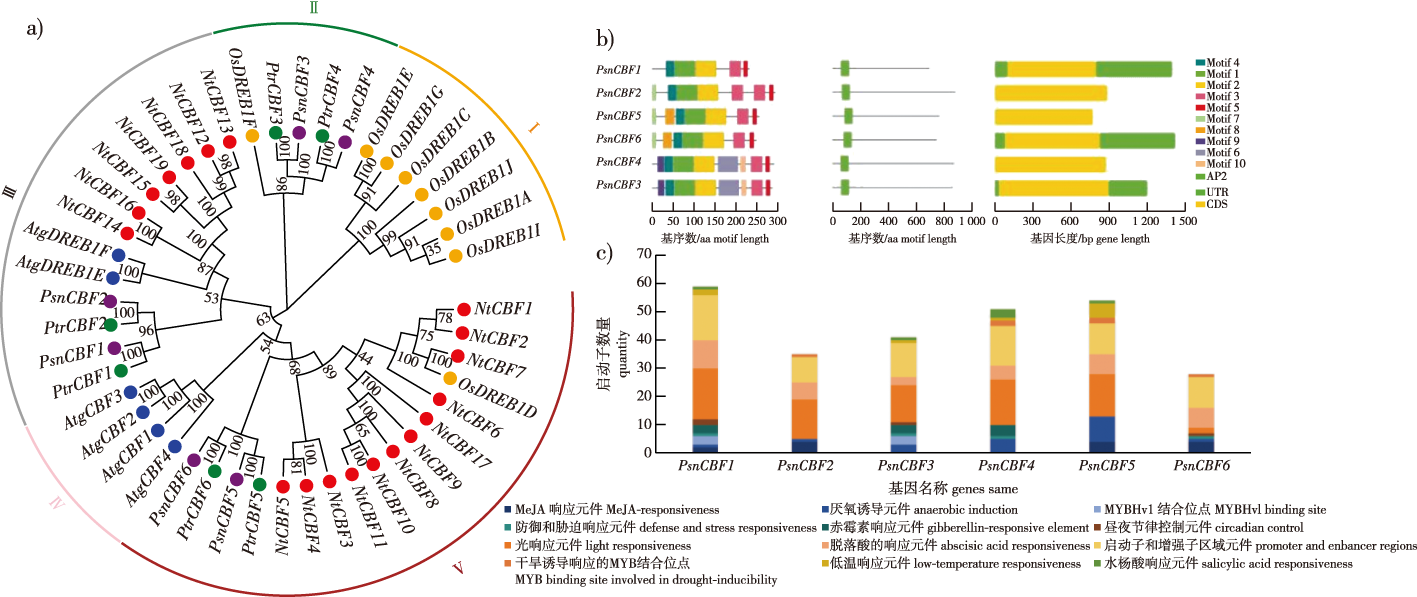
【Objective】The haploid cell line ‘Qu-1’, derived from in vitro anther culture of the diploid hybrid poplar Populus × xiaohei, possesses the dual advantages of a suspension culture system and haploid genomics. This unique biological material offers significant potential for functional gene studies and secondary metabolite analysis in woody plants, facilitating genetic manipulation and omics-based research due to its single gene copy number. The C-repeat Binding Factor (CBF) gene family, also known as the DREB1 subfamily, plays a pivotal role as a master transcriptional regulator in plant cold acclimation pathways. This study aims to conduct a systematic, genome-wide identification and characterization of the CBF gene family in the Qu-1 cell line. Furthermore, we investigated the dynamic expression patterns of the identified PsnCBF genes under a controlled low-temperature stress and elucidate the concomitant physiological alterations. The findings are expected to provide fundamental insights into the molecular mechanisms of cold response in poplar at the cellular level and to evaluate the robustness of the Qu-1 cell line as a model system for functional genomics research in perennial woody species.【Method】A genome-wide identification of CBF genes was performed on the Qu-1 cell line genome. The identification was based on hidden Markov model (HMM) profiles of the AP2/ERF DNA-binding domain and specific amino acid signatures characteristic of CBF proteins. The identified PsnCBF genes were subjected to comprehensive bioinformatic analyses. Multiple sequence alignments and phylogenetic tree construction were carried out using MEGA 11.0 software with the neighbor-joining method, and bootstrap analysis with 1 000 replicates was performed to assess node reliability. The chromosomal locations were mapped using TBtools software. Gene structure (intron/exon) diagrams were generated based on alignment of the coding sequences with their corresponding genomic sequences. Conserved protein motifs were analyzed using the MEME suite. Putative cis-acting regulatory elements within the 2 000 bp promoter region upstream of the translational start site of each PsnCBF gene were predicted using the PlantCARE database. For expression analysis, Qu-1 suspension cells in the logarithmic growth phase were subjected to a low-temperature treatment at 4℃. Cells were harvested at 0, 1, 3, 6, 12 and 24 hours post-treatment. Total RNA was extracted using a modified CTAB method, followed by DNase I treatment to remove genomic DNA contamination. First-strand cDNA was synthesized using a reverse transcription kit. Quantitative real-time PCR (qRT-PCR) was performed on a Bio-Rad CFX96 system using SYBR Green master mix. The PsnActin gene served as an internal reference for normalization of gene expression data. The relative expression levels were calculated using the 2-ΔΔCt method, with three biological replicates and three technical replicates for each sample. Parallel physiological assays were conducted. The activities of key antioxidant enzymes, including peroxidase (POD), were determined using commercial assay kits following the manufacturer’s instructions.【Result】(1) A total of six non-redundant CBF genes, designated as PsnCBF1 to PsnCBF6, were identified in the Qu-1 cell line genome. Phylogenetic analysis classified these PsnCBFs into three distinct subgroups (Group Ⅰ, Ⅱ and Ⅲ), with members from Arabidopsis thaliana and other Populus species clustering accordingly, suggesting evolutionary conservation and potential functional divergence. (2) Chromosomal localization revealed that the six PsnCBF genes were unevenly distributed across four different chromosomes of Populus × xiaohei. No tandem duplication events were detected among these genes. (3) Promoter analysis indicated that all PsnCBF promoters contained multiple cis-elements associated with abiotic stress responses and hormone signaling. Key elements identified included ABA-responsive elements (ABRE), low-temperature-responsive elements (LTRE/DRE/CRT), MYB and MYC recognition sites involved in drought and cold stress, and MeJA-responsive elements (CGTCA-motif and TGACG-motif). (4) The qRT-PCR analysis revealed that low-temperature stress significantly influenced the expression patterns of all six PsnCBF genes, but with distinct kinetic profiles among members. Compared to the untreated control (0 hour), PsnCBF1, PsnCBF3, and PsnCBF5 exhibited a rapid and strong induction, with transcript levels peaking sharply at three to six hours after treatment before gradually declining. In contrast, PsnCBF2 and PsnCBF4 showed a more sustained and moderate up-regulation throughout the 24-hours treatment period. PsnCBF6 displayed a delayed response, with significant induction observed only after 12 hours of stress. (5) Physiological analyses demonstrated that low-temperature treatment induced a time-dependent accumulation of H2O2 and O2- in Qu-1 cells, which was visually confirmed by intensified DAB and NBT staining. Electrolyte leakage increased progressively, indicating enhanced membrane damage over time. In response to this oxidative burst, the activities of antioxidant enzymes were markedly altered. POD activity exhibited the most pronounced and consistent increase, rising steadily from three hours onwards and reaching a level approximately 3.2-fold higher than the control at 24 hours.【Conclusion】The CBF gene family identified in the haploid Populus × xiaohei Qu-1 cell line shares conserved structural features with its counterparts in other plant species, confirming its identity within this critical transcription factor family. Low-temperature stress exerts a significant and complex impact on the relative expression levels of PsnCBFs, with members displaying divergent temporal induction patterns, which suggests potential functional specialization or differential regulation within the cold-response network. At the physiological level, the Qu-1 cell line experiences low-temperature-induced oxidative stress, as evidenced by ROS accumulation and membrane damage. However, it actively mobilizes a defense response, primarily through a substantial and sustained enhancement of POD activity, to mitigate oxidative injury within a certain stress duration window. These coordinated molecular and physiological responses demonstrate that the Qu-1 haploid cell line retains intact and functional cold-signaling and stress-adaptation pathways. This study provides a comprehensive molecular and physiological profile of the cold response in a poplar cell line, thereby strongly supporting the utility of the Populus × xiaohei Qu-1 haploid cell line as a valid and efficient model system for dissecting gene function, particularly for abiotic stress tolerance mechanisms in woody plants.
 PDF(2228 KB)