PDF(1986 KB)

Efficient prediction model for crown ratio of Larix olgensis plantations based on nonlinear mixed-effects model
Liu Shuaidong, Miao Zheng, Hao Yuanshuo, Dong Lihu
Journal of Nanjing Forestry University (Natural Sciences Edition) ›› 2026, Vol. 50 ›› Issue (5) : 152-160.
PDF(1986 KB)
 PDF(1986 KB)
Efficient prediction model for crown ratio of Larix olgensis plantations based on nonlinear mixed-effects model
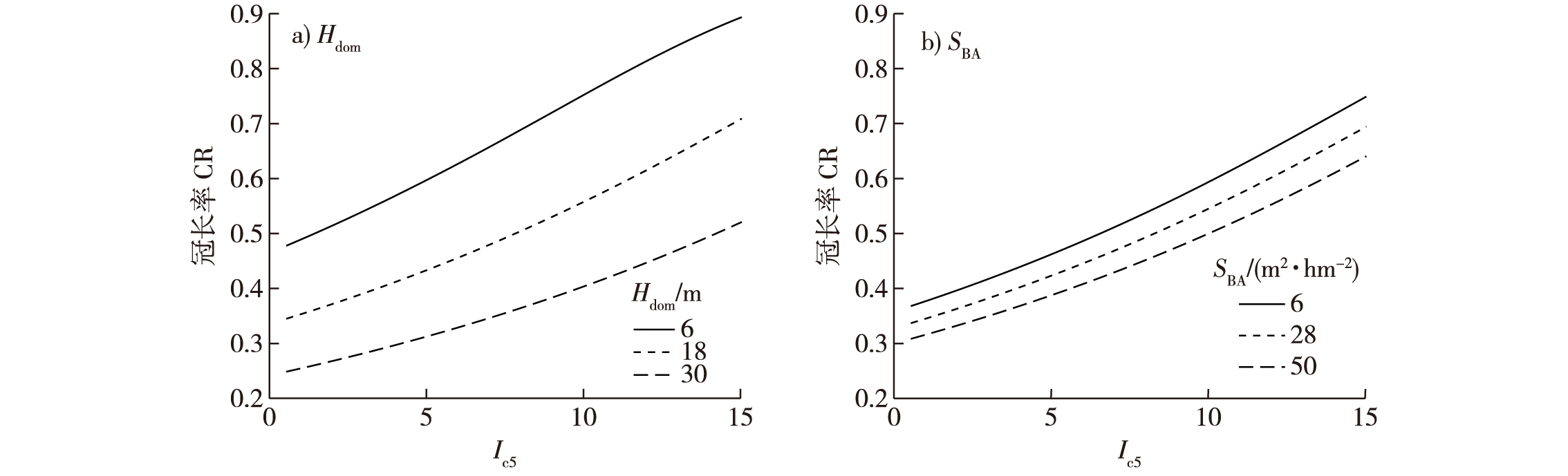
【Objective】Crown ratio (CR) is a vital indicator of tree vigor and a fundamental parameter for stand growth prediction. However, high-precision CR prediction models specifically for Larix olgensis plantations remain scarce, and the key driving factors are not yet fully understood. Furthermore, existing models often rely on variables such as total tree height and height to crown base, which are costly and difficult to measure. Therefore, this study aimed to develop a nonlinear mixed-effects (NLME) crown ratio model for L. olgensis plantations using easily obtainable variables and to determine an efficient calibration strategy for prediction to support precision forest management. 【Method】The study utilized observation data from 463 sample plots of L. olgensis in the Dongjingcheng Forestry Bureau, Linkou Forestry Bureau, and Mengjiagang Forest Farm in Heilongjiang Province. A Richards function was selected as the basic model. Stepwise regression was employed to incorporate stand mean dominant height, stand basal area per hectare, and a distance-dependent competition index (Ic5) as covariates to construct the NLME model. Leave-one-out cross-validation and random sampling calibration schemes were employed to analyze the effects of different calibration sample sizes (ranging from 1 to 20 trees) on model prediction accuracy. 【Result】The developed NLME model demonstrated good goodness-of-fit, with an adjusted coefficient of determination (
crown ratio / Larix olgensis / nonlinear mixed-effects model / sampling calibration
| [1] |
郭孝玉. 长白落叶松人工林树冠结构及生长模型研究[D]. 北京: 北京林业大学, 2013.
|
| [2] |
|
| [3] |
|
| [4] |
|
| [5] |
|
| [6] |
|
| [7] |
|
| [8] |
|
| [9] |
|
| [10] |
|
| [11] |
|
| [12] |
|
| [13] |
|
| [14] |
|
| [15] |
卢军, 李凤日, 张会儒, 等. 帽儿山天然次生林主要树种冠长率模型[J]. 林业科学, 2011, 47(6):70-76.
|
| [16] |
|
| [17] |
刘奇峰, 陈东升, 冯健, 等. 辽东山区人工红松冠长率影响因子研究[J]. 林业科学研究, 2022, 35(6):127-134.
|
| [18] |
|
| [19] |
|
| [20] |
易达, 李凤日, 马爱云, 等. 基于混合效应模型和分位数回归的长白落叶松枝下高模型构建[J]. 应用生态学报, 2023, 34(4):1035-1042.
|
| [21] |
马爱云, 李凤日, 董利虎. 应用混合效应法建立的杂种落叶松人工林单木冠幅预测模型[J]. 东北林业大学学报, 2021, 49(3):9-14,38.
|
| [22] |
|
| [23] |
宋争, 黄朗, 胡松, 等. 基于立地混合效应的湖南丘陵平原区杉木多形立地指数模型研究[J]. 林业科学研究, 2022, 35(5):172-179.
|
| [24] |
袁慧, 杜超群, 赵小涛, 等. 基于混合效应的湖北杉木冠长率模型[J]. 中国农学通报, 2021, 37(4):31-37.
|
| [25] |
|
| [26] |
|
| [27] |
|
| [28] |
|
| [29] |
刘兆刚, 李凤日, 于金成. 落叶松人工林单木模型的研究[J]. 植物研究, 2003, 23(2):237-244.
|
| [30] |
|
| [31] |
江希钿, 陈学文, 林纪建. 以Von Bertalanffy生长理论为基础的单木生长模型[J]. 中南林业调查规划, 1994, 13(4):5-7.
|
| [32] |
|
| [33] |
|
| [34] |
孙宇, 李凤日, 谢龙飞, 等. 基于林分及地形因子的落叶松人工林林分生物量模型构建[J]. 南京林业大学学报(自然科学版), 2023, 47(3):129-136.
|
| [35] |
|
| [36] |
|
| [37] |
|
| [38] |
|
| [39] |
|
/
| 〈 |
|
〉 |