PDF(2521 KB)

Effects of different carrier microbial fertilizers on alfalfa growth, soil nutrients and enzyme activity
Chen Ying, Nie Hui, Zhang Jinchi, Tong Guoqing, Liu Qianqian, Liu Xin, Sun Lianhao, Zhang Xiongfei, Xue Rengui
Journal of Nanjing Forestry University (Natural Sciences Edition) ›› 2026, Vol. 50 ›› Issue (5) : 209-218.
PDF(2521 KB)
 PDF(2521 KB)
Effects of different carrier microbial fertilizers on alfalfa growth, soil nutrients and enzyme activity
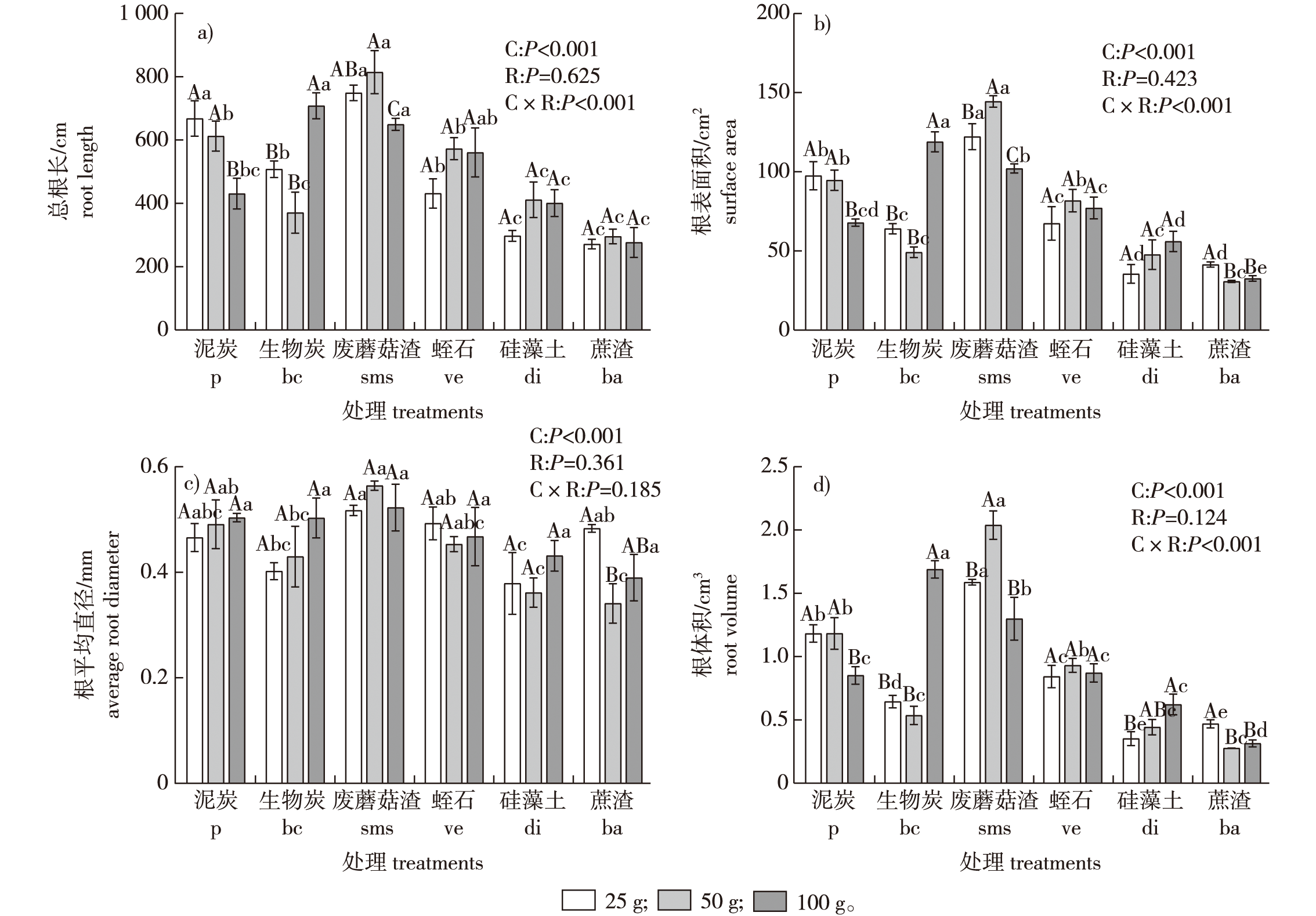
【Objective】This study aims to evaluate the effects of microbial fertilizers prepared with different carrier materials and plant growth-promoting rhizobacteria (PGPR) on plant growth and soil environmental improvement, and to identify suitable carrier materials for microbial fertilizer production. 【Method】A pot experiment was conducted using Bacillus thuringiensis (NL-11) as the PGPR strain. Microbial fertilizers were prepared using peat (p), biochar (bc), spent mushroom substrate (sms), vermiculite (ve), diatomite (di), and bagasse (ba) as carrier materials. Three application rates (25 g, 50 g, and 100 g) were tested to determine the optimal carrier and dosage. Root morphology, plant biomass of Medicago sativa, soil physicochemical properties, and soil enzyme activities were measured under different treatments. 【Result】Compared with peat-based microbial fertilizer, microbial fertilizers prepared with the five alternative carriers improved plant growth and soil nutrient conditions to varying degrees. Among them, the spent mushroom substrate-based fertilizer showed the most pronounced effects. Plant biomass increased significantly by 76.25%-149.6%, while soil pH increased by 7.85%-17.89%. The contents of available phosphorus, ammonium nitrogen, nitrate nitrogen, total carbon, total sulfur, and total phosphorus were also significantly enhanced. In addition, the spent mushroom substrate-based fertilizer significantly improved soil multifunctionality. Among the three application rates, 100 g showed the best performance in promoting plant growth and improving soil conditions. Linear regression analysis indicated significant correlations between soil multifunctionality and both soil pH and plant biomass. 【Correlation】 Analysis further revealed significant positive relationships between soil multifunctionality and biomass, total carbon, and several soil nutrient indicators. Random forest analysis showed that soil total carbon was the most important predictor of plant biomass variation.
microbial fertilisers / carrier / root growth / soil nutrients / soil enzyme activity / Medicago sativa
| [1] |
胡基华, 张烨, 张淑梅, 等. 微生物菌肥对寒地大豆根际土壤真菌多样性的影响[J]. 大豆科学, 2021, 40(6):805-812.
|
| [2] |
胡博均, 吴心怡, 赵蕊, 等. 微生物肥料载体的作用及新型载体的研发[J]. 农业装备技术, 2025, 51(4):4-6,10.
|
| [3] |
|
| [4] |
|
| [5] |
|
| [6] |
|
| [7] |
|
| [8] |
|
| [9] |
刘雯雯, 姚拓, 孙丽娜, 等. 菌糠作为微生物肥料载体的研究[J]. 农业环境科学学报, 2008, 27(2):787-791.
|
| [10] |
|
| [11] |
李永兴, 匡柏健, 李久蒂. 不同载体对微生物菌剂质量的影响[J]. 土壤肥料, 1999(6):30-32.
|
| [12] |
|
| [13] |
|
| [14] |
|
| [15] |
珊丹, 邢恩德, 荣浩, 等. 草原矿区排土场不同植被配置类型生态恢复[J]. 生态学杂志, 2019, 38(2):336-342.
|
| [16] |
朱玉. 复合菌肥研制及其在毫菊种植上的应用[D]. 阜阳: 阜阳师范大学, 2020.
|
| [17] |
鲁如坤. 土壤农业化学分析方法[M]. 北京: 中国农业科学技术出版社, 2000.
|
| [18] |
|
| [19] |
|
| [20] |
|
| [21] |
|
| [22] |
|
| [23] |
|
| [24] |
|
| [25] |
邹锦丰, 周传志. 微生物肥料研究进展及发展前景[J]. 现代农业科技, 2021(22):142-144.
|
| [26] |
刘学生. 菌糠和堆肥菌糠对铅污染黑土和红壤的修复[D]. 哈尔滨: 东北农业大学, 2019.
|
| [27] |
林俊铭. 黑皮鸡枞菌糠菌肥的制备及其在小白菜种植中的应用[D]. 佛山: 佛山科学技术学院, 2023.
|
| [28] |
|
| [29] |
杨皓, 刘超, 庄家尧, 等. 不同载体菌肥对紫穗槐生长和光合特性及土壤养分的影响[J]. 南京林业大学学报(自然科学版), 2024, 48(3):81-89.
|
| [30] |
卢培娜. 菌肥与腐熟秸秆对盐碱地燕麦土壤微生态环境的调控机制[D]. 呼和浩特: 内蒙古农业大学, 2021.
|
| [31] |
卢钰升, 顾文杰, 蒋瑞萍, 等. 解淀粉芽孢杆菌GB58对水稻纹枯病的防效及菌剂载体筛选[J]. 中国农学通报, 2017, 33(11):119-125.
|
| [32] |
|
| [33] |
|
| [34] |
|
| [35] |
|
| [36] |
孙波, 赵其国, 张桃林, 等. 土壤质量与持续环境--Ⅲ.土壤质量评价的生物学指标[J]. 土壤, 1997(5):225-234.
|
| [37] |
|
| [38] |
|
| [39] |
|
| [40] |
|
/
| 〈 |
|
〉 |