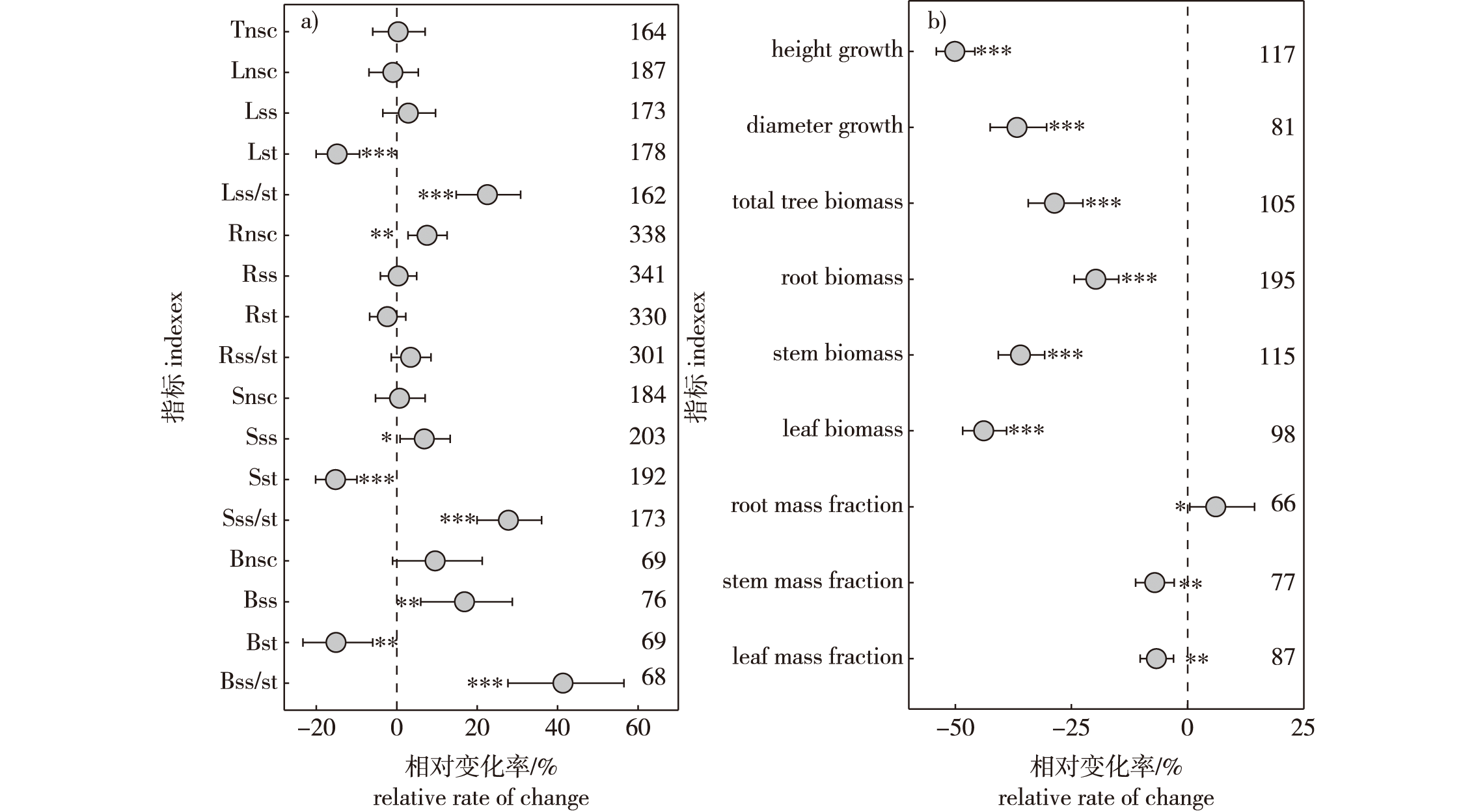
【Objective】This study aims to enhance the understanding of tree response patterns to environmental stresses and their underlying regulatory mechanisms by comprehensively assessing the effects of drought stress on non-structural carbohydrate (NSC) dynamics and growth in trees.【Method】Existing drought stress experiments that simultaneously observed tree NSC indicators and growth were systematically collected. Using meta-analysis, the response patterns of different functional tree types to drought were quantitatively evaluated, and the relationships between these responses and drought intensity as well as duration were explored.【Result】(1)Trees under drought stress generally maintained nonstructural carbohydrate (NSC) concentrations while significantly reducing growth rates. Specifically, aboveground NSC remained stable, and the conversion of starch to soluble sugar was promoted,whereas root NSC increased significantly. Radial growth, tree height increment, and total biomass accumulation decreased by 36.68%, 50.07%, and 28.64%, respectively; (2) Responses varied by different leaf habit tree species: deciduous trees showed increased NSC in branches and roots with biomass allocation shifting toward roots, while evergreen trees maintained stable above ground NSC but exhibited more pronounced starch to sugar conversion in roots, with less drought impact on biomass allocation among organs;(3) Drought intensity and duration affect the starch and growth dynamics of some functional organs: Drought intensity mainly affects the starch concentration and biomass accumulation of roots and stems, showing a significant negative correlation; while drought duration is significantly negatively correlated with stem biomass accumulation, but positively correlated with root biomass accumulation. 【Conclusion】Under drought stress, trees generally adopt a conservative strategy of restricting growth and enhancing or maintaining NSC reserves, so the priority of carbon storage is usually higher than that of structural growth; carbon allocation tends to shift to roots to maintain water acquisition ability and basic metabolic processes, thereby enhancing the tree’s tolerance to water stress. This study helps deepen the understanding of the dynamic regulation mechanism of carbon allocation in trees under drought, and provides a basis and reference for predicting the carbon sink capacity of forests under future climate change scenarios.
 PDF(2861 KB)