Identification of the bZIP gene family in Populus alba × P. glandulosa ‘84K’ and functional analysis of PagbZIP36

He Dongyan, Tan Shuxian, Cheng Zhen, Xie Jianbo

Journal of Nanjing Forestry University (Natural Sciences Edition) ›› 2026, Vol. 50 ›› Issue (4) : 84-96.

PDF(4869 KB)
PDF(4869 KB)
Journal of Nanjing Forestry University (Natural Sciences Edition) ›› 2026, Vol. 50 ›› Issue (4) : 84-96. DOI: 10.12302/j.issn.1000-2006.202603020

Identification of the bZIP gene family in Populus alba × P. glandulosa ‘84K’ and functional analysis of PagbZIP36

Author information +
History +

Abstract

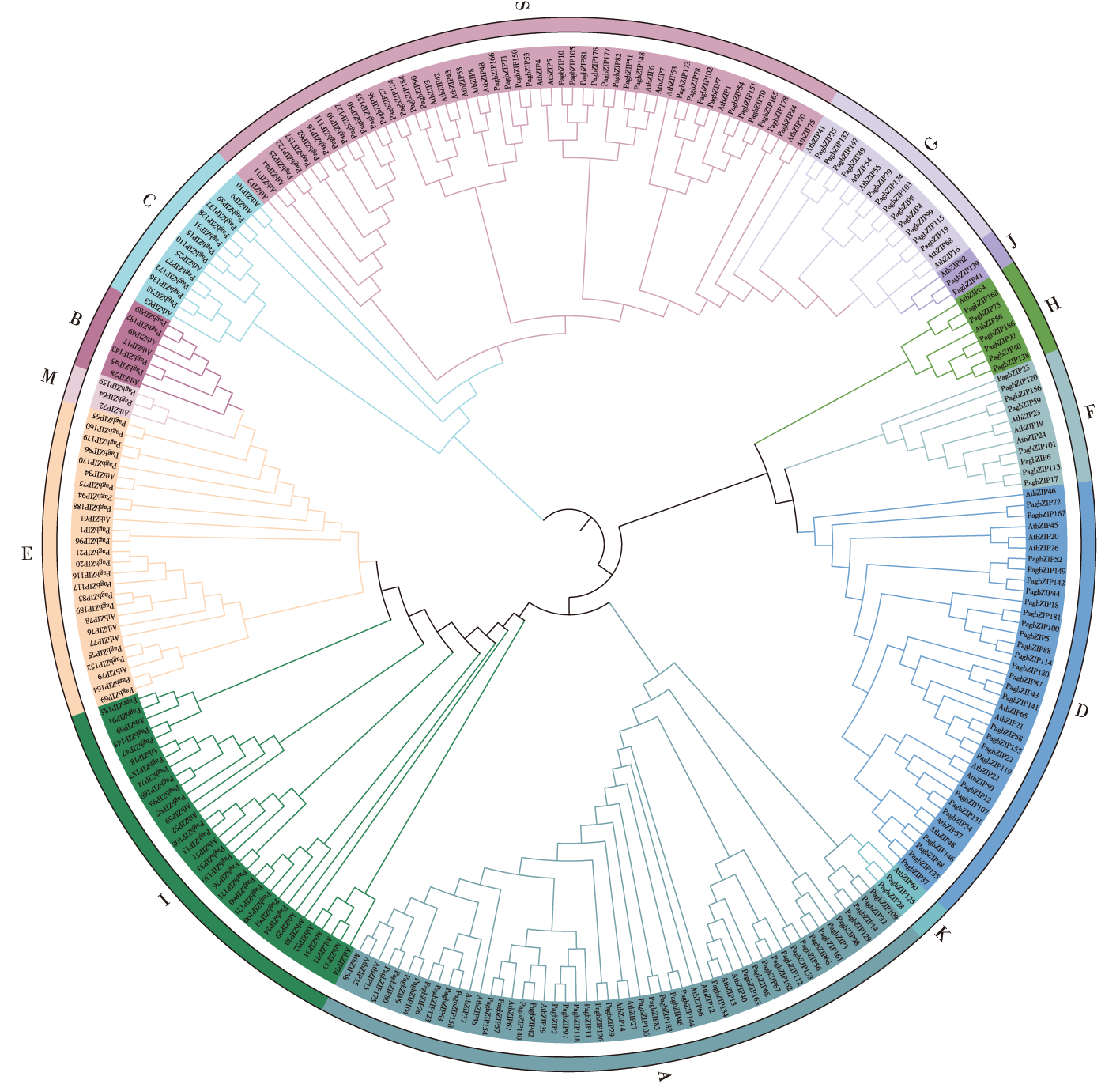
【Objective】Soil salt stress is one of the major abiotic stresses that severely inhibits plant growth, development and productivity. Elucidating the molecular regulatory mechanisms of plant responses to salt stress is of great theoretical and practical significance for breeding stress-resistant forest trees and promoting their genetic improvement. In this study, ‘84K’ poplar (Populus alba × P. glandulosa ‘84K’), a widely used model tree in genetic research, was used as the experimental material. The structural and evolutionary characteristics of the bZIP transcription factor gene family were systematically identified and analyzed, and the biological function and molecular regulatory mechanism of PagbZIP36 in response to salt stress were further explored, aiming to provide reliable gene resources and theoretical support for molecular breeding of stress-resistant forest trees.【Method】A comprehensive bioinformatics analysis was performed to characterize the gene structure, phylogenetic relationships, conserved motifs and promoter cis-elements of the bZIP gene family. The expression pattern of PagbZIP36 under salt treatment was detected, and its salt tolerance function was identified through phenotypic observation and physiological index determination in transgenic poplar. In addition, DAP-seq combined with molecular biology experiments was used to verify the regulatory relationship between PagbZIP36 and its downstream target gene PagGolS2 during salt stress response.【Result】A total of 190 bZIP family members were identified from the ‘84K’ poplar genome and were divided into 13 distinct subfamilies. PagbZIP36, a member of the S subfamily, contained 70.1% salt stress-related cis-acting elements in its promoter region and was significantly induced by salt stress. Overexpression of PagbZIP36 significantly enhanced salt tolerance in transgenic ‘84K’ poplar. Further mechanistic analysis indicated that this transcription factor regulates the expression of the downstream functional gene PagGolS2, enhances reactive oxygen species scavenging efficiency, maintains cell membrane stability, effectively alleviates oxidative damage caused by high salt, and ultimately improves poplar salt tolerance.【Conclusion】Members of the bZIP S subfamily exert pivotal roles in plant salt stress response and tolerance. Among these regulators, PagbZIP36 enhances reactive oxygen species scavenging capacity and maintains cell membrane stability by targeting and modulating the expression of PagGolS2, thereby conferring significantly elevated salt tolerance in forest trees. This study provides critical candidate genes and a robust theoretical foundation for molecular breeding programs aimed at improving stress resistance in forest trees.
Key words

forest tree / genetics and breeding / salt stress response / bZIP gene family / Populus alba × P. glandulosa ‘84K’ / PagbZIP36

Cite this article

Download Citations
He Dongyan , Tan Shuxian , Cheng Zhen , et al. Identification of the bZIP gene family in Populus alba × P. glandulosa ‘84K’ and functional analysis of PagbZIP36[J]. Journal of Nanjing Forestry University (Natural Sciences Edition). 2026, 50(4): 84-96 https://doi.org/10.12302/j.issn.1000-2006.202603020

References

[1]
Hussain S, Hussain S, Ali B, et al. Recent progress in understanding salinity tolerance in plants:story of Na+/K+ balance and beyond[J]. Plant Physiology and Biochemistry, 2021, 160:239-256. DOI:10.1016/j.plaphy.2021.01.029.
[2]
Liu H T, Tang X, Zhang N, et al. Role of bZIP transcription factors in plant salt stress[J]. International Journal of Molecular Sciences, 2023, 24(9):7893. DOI:10.3390/ijms24097893.
[3]
Wang T T, Yang J Q, Cao J M, et al. MsbZIP55 regulates salinity tolerance by modulating melatonin biosynthesis in alfalfa[J]. Plant Biotechnology Journal, 2025, 23(6):2125-2139. DOI:10.1111/pbi.70035.
[4]
Yang Y L, Xu Y, Feng B Z, et al. Regulatory networks of bZIPs in drought,salt and cold stress response and signaling[J]. Plant Science, 2025, 352:112399. DOI:10.1016/j.plantsci.2025.112399.
[5]
Wang B X, Liu Y, Wang Y F, et al. OsbZIP72 is involved in transcriptional gene-regulation pathway of abscisic acid signal transduction by activating rice high-affinity potassium transporter OsHKT1;1[J]. Rice Science, 2021, 28(3):257-267. DOI:10.1016/j.rsci.2021.04.005.
[6]
Deng C P, Shi M, Fu R, et al. ABA-responsive transcription factor bZIP1 is involved in modulating biosynthesis of phenolic acids and tanshinones in Salvia miltiorrhiza[J]. Journal of Experimental Botany, 2020, 71(19):5948-5962. DOI:10.1093/jxb/eraa295.
[7]
Schindler U, Terzaghi W, Beckmann H, et al. DNA binding site preferences and transcriptional activation properties of the Arabidopsis transcription factor GBF1[J]. The EMBO Journal, 1992, 11(4):1275-1289. DOI:10.1002/j.1460-2075.1992.tb05171.x.
[8]
Dröge-Laser W, Snoek B L, Snel B, et al. The Arabidopsis bZIP transcription factor family:an update[J]. Current Opinion in Plant Biology, 2018, 45:36-49. DOI:10.1016/j.pbi.2018.05.001.
[9]
Nijhawan A, Jain M, Tyagi A K, et al. Genomic survey and gene expression analysis of the basic leucine zipper transcription factor family in rice[J]. Plant Physiology, 2008, 146(2):323-324. DOI:10.1104/pp.107.112821.
[10]
Wei K F, Chen J, Wang Y M, et al. Genome-wide analysis of bZIP-encoding genes in maize[J]. DNA Research, 2012, 19(6):463-476. DOI:10.1093/dnares/dss026.
[11]
Liang Y, Xia J Q, Jiang Y S, et al. Genome-wide identification and analysis of bZIP gene family and resistance of TaABI 5 (TabZIP96) under freezing stress in wheat (Triticum aestivum)[J]. International Journal of Molecular Sciences, 2022, 23(4):2351. DOI:10.3390/ijms23042351.
[12]
Zhong X J, Feng X Q, Li Y L, et al. Genome-wide identification of bZIP transcription factor genes related to starch synthesis in barley (Hordeum vulgare L.)[J]. Genome, 2021, 64(12):1067-1080. DOI:10.1139/gen-2020-0195.
[13]
Jakoby M, Weisshaar B, Dröge-Laser W, et al. bZIP transcription factors in Arabidopsis[J]. Trends in Plant Science, 2002, 7(3):106-111. DOI:10.1016/S1360-1385(01)02223-3.
[14]
Gao S, Gao J, Zhu X Y, et al. ABF 2 ABF3,and ABF4 promote ABA-mediated chlorophyll degradation and leaf senescence by transcriptional activation of chlorophyll catabolic genes and senescence-associated genes in Arabidopsis[J]. Molecular Plant, 2016, 9(9):1272-1285. DOI:10.1016/j.molp.2016.06.006.
[15]
Yu Y, Qian Y C, Jiang M Y, et al. Regulation mechanisms of plant basic leucine zippers to various abiotic stresses[J]. Frontiers in Plant Science, 2020, 11:1258. DOI:10.3389/fpls.2020.01258.
[16]
Sun X L, Li Y, Cai H, et al. The Arabidopsis AtbZIP1 transcription factor is a positive regulator of plant tolerance to salt,osmotic and drought stresses[J]. Journal of Plant Research, 2012, 125(3):429-438. DOI:10.1007/s10265-011-0448-4.
[17]
Yang S, Zong W T, Shi L L, et al. PPGR:a comprehensive perennial plant genomes and regulation database[J]. Nucleic Acids Research, 2024, 52(D1):D1588-D1596. DOI:10.1093/nar/gkad963.
[18]
Livak K J, Schmittgen T D. Analysis of relative gene expression data using real-time quantitative PCR and the 2-ΔΔC T method[J]. Methods, 2001, 25(4):402-408. DOI:10.1006/meth.2001.1262.
[19]
Arnon D I. Copper enzymes in isolated chloroplasts. Polyphenoloxidase in Beta vulgaris[J]. Plant Physiology, 1949, 24(1): 1-15. DOI: 10.1104/pp.24.1.1.
[20]
周伟明, 王如意, 陈柳生, 等. ICP-OES法测定马缨丹不同部位中22种无机元素的含量[J]. 中药材, 2014, 37(10): 1753-1757.
Zhou W M, Wang R Y, Chen L S, et al. Determination of 22 inorganic elements in different parts of Lantana camara by ICP-OES[J]. Journal of Chinese Medicinal Materials, 2014, 37(10): 1753-1757.DOI: 10.13863/j.issn1001-4454.2014.09.010.
[21]
Bartlett A, O’Malley R C, Huang S C, et al. Mapping genome-wide transcription-factor binding sites using DAP-seq[J]. Nature Protocols, 2017, 12(8):1659-1672. DOI:10.1038/nprot.2017.055.
[22]
朱佳梦, 江海洋, 陈茹梅, 等. 通过荧光标记的凝胶阻滞技术分析Opaque2蛋白与ZmGRAS11启动子的结合位点[J]. 生物技术进展, 2022, 12(6):880-887.
Zhu J M, Jiang H Y, Chen R M, et al. EMSA experiments with fluorescently labeled probes to analyze the binding sites of Opaque2 protein with the ZmGRAS11 promoter[J]. Current Biotechnology, 2022, 12(6):880-887. DOI:10.19586/j.2095-2341.2022.0084.
[23]
曹佳琰, 王惠玉, 韩莹琰. 酵母单杂交技术验证叶用莴苣LsHPB互作启动子[J]. 北京农学院学报, 2025, 40(1):37-43.
Cao J Y, Wang H Y, Han Y Y. Validation of LsHPB interaction promoter of leaf lettuce by yeast one hybrid[J]. Journal of Beijing University of Agriculture, 2025, 40(1):37-43. DOI:10.13473/j.cnki.issn.1002-3186.2025.0107.
[24]
Izawa T, Foster R, Chua N H. Plant bZIP protein DNA binding specificity[J]. Journal of Molecular Biology, 1993, 230(4):1131-1144. DOI:10.1006/jmbi.1993.1230.
[25]
徐金龙, 张文静, 向凤宁. 植物盐胁迫诱导启动子及其顺式作用元件研究进展[J]. 植物生理学报, 2021, 57(4):759-766.
Xu J L, Zhang W J, Xiang F N. Advances in stress inducible promoter and cis-acting elements in higher plants[J]. Plant Physiology Journal, 2021, 57(4):759-766. DOI:10.13592/j.cnki.ppj.2020.0221.
[26]
马博涛, 伍国强, 魏明. bZIP转录因子在植物逆境胁迫响应和生长发育中的作用[J]. 生物技术通报, 2024, 40(9):148-160.
Ma B T, Wu G Q, Wei M. Roles of bZIP transcription factor in the response to stresses,and growth and development in plants[J]. Biotechnology Bulletin, 2024, 40(9):148-160. DOI:10.13560/j.cnki.biotech.bull.1985.2023-1176.
[27]
Yang Y Q, Guo Y. Unraveling salt stress signaling in plants[J]. Journal of Integrative Plant Biology, 2018, 60(9):796-804. DOI:10.1111/jipb.12689.
[28]
Li Z Q, Cheng L, Li S T, et al. Physiological,ionomic,transcriptomic and metabolomic analyses reveal molecular mechanisms of root adaption to salt stress in water spinach[J]. BMC Genomics, 2025, 26(1):231. DOI:10.1186/s12864-025-11409-z.
[29]
Skorupa M, Golebiewski M, Domagalski K, et al. Transcriptomic profiling of the salt stress response in excised leaves of the halophyte Beta vulgaris ssp. maritima[J]. Plant Science, 2016, 243:56-70. DOI:10.1016/j.plantsci.2015.11.007.
[30]
Lu X F, Cui J, Qi J, et al. The strigolactones-mediated DNA demethylation activates the phosphoinositide pathway in response to salt stress[J]. International Journal of Biological Macromolecules, 2025, 301:139954. DOI:10.1016/j.ijbiomac.2025.139954.
[31]
Dabravolski S A, Isayenkov S V. The regulation of plant cell wall organisation under salt stress[J]. Frontiers in Plant Science, 2023, 14:1118313. DOI:10.3389/fpls.2023.1118313.
[32]
Liu L, Wu X L, Sun W B, et al. Galactinol synthase confers salt-stress tolerance by regulating the synthesis of galactinol and raffinose family oligosaccharides in poplar[J]. Industrial Crops and Products, 2021, 165:113432. DOI:10.1016/j.indcrop.2021.113432.
[33]
庄文慧, 杨露, 邵莉颖, 等. 林木中bZIP转录因子的抗逆研究进展[J]. 分子植物育种, 2025, 23(24):8307-8313.
Zhuang W H, Yang L, Shao L Y, et al. Research progress on stress resistance of bZIP transcription factors in forest trees[J]. Molecular Plant Breeding, 2025, 23(24):8307-8313. DOI:10.13271/j.mpb.023.008307.
PDF(4869 KB)

Accesses

Citation

Detail

Sections
Recommended
The full text is translated into English by AI, aiming to facilitate reading and comprehension. The core content is subject to the explanation in Chinese.

/