Advances in UAV remote sensing for forest tree phenotyping and genetic breeding

LUAN Qifu, LYU Nanxi, Jiang Jingmin, LI Yanjie

Journal of Nanjing Forestry University (Natural Sciences Edition) ›› 0

PDF(1624 KB)
PDF(1624 KB)
Journal of Nanjing Forestry University (Natural Sciences Edition) ›› 0 DOI: 10.12302/j.issn.1000-2006.202604026

Advances in UAV remote sensing for forest tree phenotyping and genetic breeding

  • LUAN Qifu, LYU Nanxi, Jiang Jingmin, LI Yanjie*
Author information +
History +

Abstract

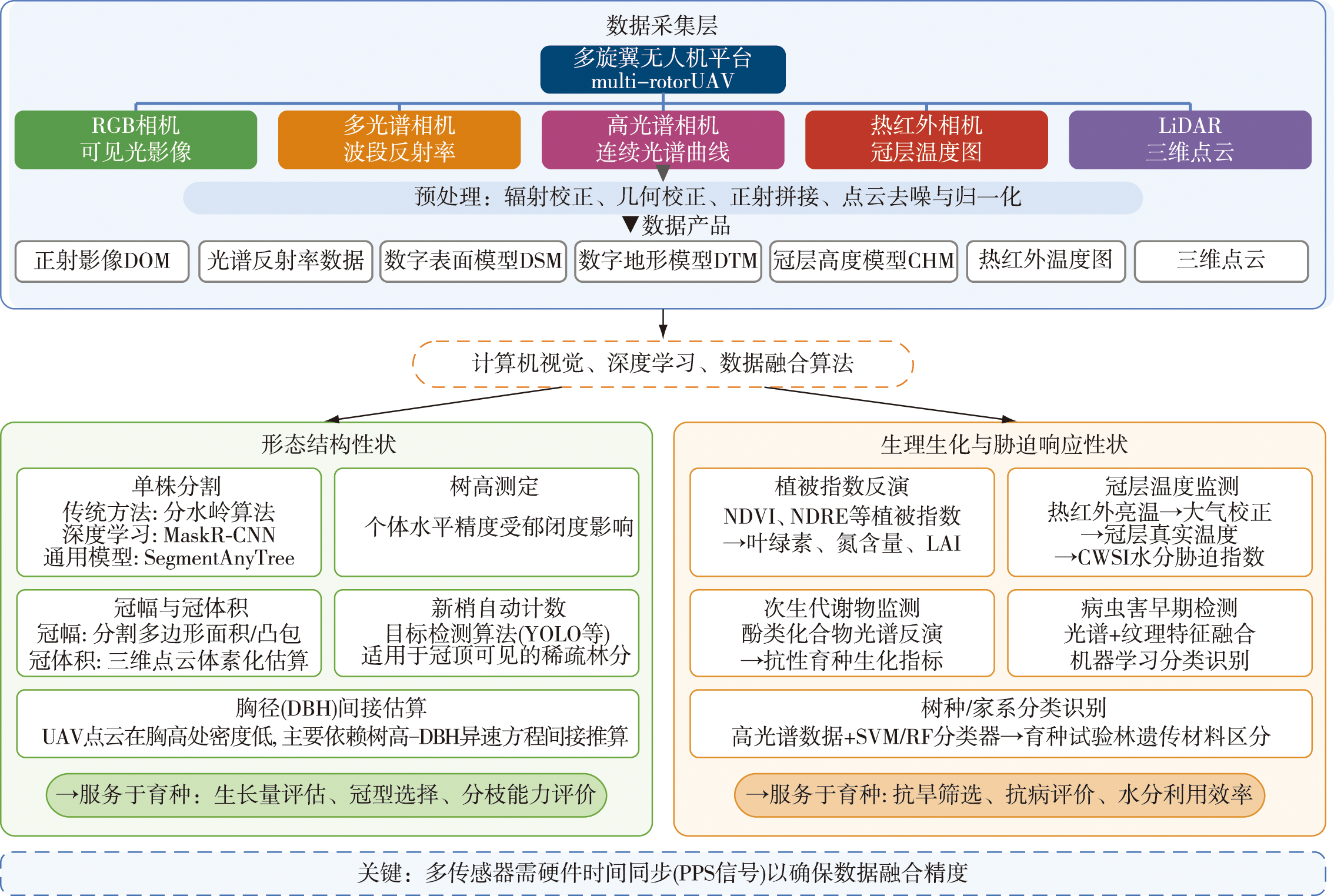
In the face of the severe and escalating challenges posed by global climate change, accelerating the breeding of new forest tree varieties that are simultaneously high-yielding, high-quality, and broadly adaptive has become an urgent imperative for safeguarding the sustainable development and ecological resilience of forest ecosystems. Forest tree genetic improvement, however, has long been hampered by the protracted breeding cycles, extensive land requirements, and substantial labor demands intrinsic to perennial woody species. Among these constraints, the acquisition of accurate, large-scale phenotypic data has proven particularly limiting. Conventional manual, ground-based phenotyping approaches—being labor-intensive, time-consuming, costly, frequently subjective, and in many cases destructive—are incapable of matching the rapidly expanding capacity of genomic data generation, thereby giving rise to the widely recognized "phenotyping bottleneck" that now constitutes a critical obstacle to the efficiency of forest tree genetic improvement. In recent years, low-altitude remote sensing based on unmanned aerial vehicles (UAVs) has rapidly evolved into an important platform for the high-throughput phenotyping (HTP) of forest trees, owing to its operational flexibility, high efficiency, non-destructive nature, repeatable temporal sampling, and superior spatiotemporal resolution, thereby offering a promising pathway to overcome this bottleneck. Structured around three interconnected dimensions—UAV platforms and sensors, phenotypic trait extraction methods, and applications in genetic breeding—this paper presents a systematic review of recent advances in this rapidly developing field, and seeks to clarify the technical pathways linking aerial data acquisition to genomic-assisted breeding decisions. First, the distinctive operational characteristics of multi-rotor and fixed-wing UAV platforms are outlined and compared, with particular attention to their respective trade-offs among endurance, payload capacity, maneuverability, and the scale of areas amenable to survey. The data acquisition capabilities of mainstream onboard sensors—including RGB, multispectral, hyperspectral, thermal infrared, and light detection and ranging (LiDAR) sensors—are systematically examined in terms of their spectral coverage, spatial resolution, and suitability for capturing specific categories of tree traits. The review further underscores the critical role of synchronized multi-sensor calibration, geometric and radiometric correction, and precise spatiotemporal registration in ensuring the accuracy and reliability of subsequent multi-source data fusion, which collectively determine the quality of all downstream phenotypic estimates. Second, the review elaborates in detail on methods for extracting key phenotypic traits from UAV-derived data through computer vision and deep learning algorithms. Morphological and structural traits, such as tree height, crown width, crown projection area, stem volume, and canopy structural complexity, are typically derived from photogrammetric point clouds, canopy height models, and LiDAR returns. Physiological and biochemical traits, including leaf chlorophyll content, canopy temperature, water status, and various vegetation indices indicative of growth vigor and stress responses, are inferred from spectral and thermal information. The accuracy, robustness, and applicable conditions of these extraction methods are critically assessed, with emphasis on how stand density, canopy closure, illumination variability, and species-specific architecture influence estimation performance. Building upon these high-throughput phenotypic datasets, the paper further examines how such data can effectively underpin quantitative genetic analyses and the construction of genomic breeding models. Specifically, it addresses the estimation of genetic parameters such as heritability and genetic correlations from densely and repeatedly sampled aerial traits; the identification of novel, dynamically expressed traits through genome-wide association studies (GWAS) that would be difficult or impossible to capture manually; and the enhancement of genomic selection (GS) prediction accuracy through the integration of high-dimensional phenotypic information as auxiliary or secondary traits. The capacity of time-series UAV phenotyping to resolve the temporal dynamics of trait expression and growth trajectories is highlighted as a particularly valuable contribution to dissecting the genetic architecture of complex, longitudinally varying traits. Finally, an in-depth analysis is provided of the key challenges that remain to be resolved. These include the persistent difficulties of reliable data acquisition in complex, heterogeneous, and topographically variable stand environments; the standardization and interoperability of multi-source, multi-temporal data; the insufficient generalization capacity and limited transferability of deep learning models across species, sites, and growth stages; and the methodological and computational obstacles to the deep integration of "phenotype-genome-environment" multi-omics data. It is further argued that dynamic genetic dissection oriented toward future climate adaptability—achieved through the longitudinal, multi-scale monitoring of how forest trees respond to environmental stressors—will constitute a vital direction for breaking the persistent bottleneck in forest tree breeding. Continued advances in UAV platforms, sensor miniaturization, robust and interpretable algorithms, and standardized analytical frameworks are expected to transform forest tree phenomics into a foundational pillar of precision, climate-resilient genetic improvement.

Key words

unmanned aerial vehicle (UAV) / high-throughput phenotyping (HTP) / forest tree genetic breeding / heritability / genomic selection(GS) / deep learning

Cite this article

Download Citations
LUAN Qifu, LYU Nanxi, Jiang Jingmin, LI Yanjie. Advances in UAV remote sensing for forest tree phenotyping and genetic breeding[J]. Journal of Nanjing Forestry University (Natural Sciences Edition). 0 https://doi.org/10.12302/j.issn.1000-2006.202604026

References

[1] Mina M,Messier C,Duveneck M J,et al.Managing for the unexpected:building resilient forest landscapes to cope with global change[J].Global Change Biology,2022,28(14):4323-4341. DOI:10.1111/gcb.16197.
[2] Thompson I, Mackey B, McNulty S,et al. A synthesis on the biodiversity-resilience relationships in forest ecosystems[J]. The Role of Forest Biodiversity in the Sustainable Use of Ecosystem Goods and Services in Agro-Forestry, Fisheries, and Forestry. Forestry and Forest Products Research Institute, Ibaraki, Japan. 2010:9-19.
[3] Kilpeläinen A,Peltola H.Carbon sequestration and storage in European forests[M]//Forest Bioeconomy and Climate Change.Cham:Springer,2022:113-128. DOI:10.1007/978-3-030-99206-4_6.
[4] Allen C D,Macalady A K,Chenchouni H,et al.A global overview of drought and heat-induced tree mortality reveals emerging climate change risks for forests[J].Forest Ecology and Management,2010,259(4):660-684. DOI:10.1016/j.foreco.2009.09.001.
[5] Cortés A J,Restrepo-Montoya M,Bedoya-Canas L E. Modern strategies to assess and breed forest tree adaptation to changing climate[J]. Frontiers in Plant Science,2020,11:583323. DOI:10.3389/fpls.2020.583323.
[6] Harfouche A,Meilan R,Kirst M,et al.Accelerating the domestication of forest trees in a changing world[J]. Trends in Plant Science,2012,17(2):64-72. DOI:10.1016/j.tplants.2011.11.005.
[7] 康向阳. 林木遗传育种研究进展[J].南京林业大学学报(自然科学版),2020,44(3):1-10.
Kang X Y.Research progress of forest genetics and tree breeding[J].Journal of Nanjing Forestry University (Natural Sciences Edition),2020,44(3):1-10. DOI:10.3969/j.issn.1000-2006.202002033.
[8] 康向阳. 论林木常规育种与非常规育种及其关系[J].北京林业大学学报,2023,45(6):1-7.
Kang X Y.On conventional and unconventional tree breeding and their relationships[J].Journal of Beijing Forestry University,2023,45(6):1-7. DOI:10.12171/j.1000-1522.20230042.
[9] Isabel N,Holliday J A,Aitken S N.Forest genomics:advancing climate adaptation,forest health,productivity,and conservation[J].Evolutionary Applications,2020,13(1):3-10. DOI:10.1111/eva.12902.
[10] Grattapaglia D,Resende M D V.Genomic selection in forest tree breeding[J].Tree Genetics & Genomes,2011,7(2):241-255. DOI:10.1007/s11295-010-0328-4.
[11] Muranty H,Jorge V,Bastien C,et al.Potential for marker-assisted selection for forest tree breeding:lessons from 20years of MAS in crops[J].Tree Genetics & Genomes,2014,10(6):1491-1510. DOI:10.1007/s11295-014-0790-5.
[12] Lebedev V G,Lebedeva T N,Chernodubov A I,et al.Genomic selection for forest tree improvement:methods,achievements and perspectives[J].Forests,2020,11(11):1190. DOI:10.3390/f11111190.
[13] 杜庆章,战鹏宇,李鹏,等.基因组选择研究进展及其在林木中的发展趋势[J].北京林业大学学报,2020,42(11):1-8.
Du Q Z,Zhan P Y,Li P,et al.Advances in genomic selection and its development trend in forest[J].Journal of Beijing Forestry University,2020,42(11):1-8.
[14] 张苗苗,王军辉,卢楠,等.林木全基因组选择研究现状和应用[J].世界林业研究,2021,34(4):26-32.
Zhang M M,Wang J H,Lu N,et al.Research progress and application of whole genome selection in forest tree breeding[J].World Forestry Research,2021,34(4):26-32. DOI:10.13348/j.cnki.sjlyyj.2021.0001.y.
[15] Cooper M,Messina C D,Podlich D,et al.Predicting the future of plant breeding:complementing empirical evaluation with genetic prediction[J].Crop & Pasture Science,2014,65(4):311-336. DOI:10.1071/cp14007.
[16] Dungey H S,Dash J P,Pont D,et al.Phenotyping whole forests will help to track genetic performance[J].Trends in Plant Science,2018,23(10):854-864. DOI:10.1016/j.tplants.2018.08.005.
[17] Bussotti F,Pollastrini M.Evaluation of leaf features in forest trees:methods,techniques,obtainable information and limits[J].Ecological Indicators,2015,52:219-230. DOI:10.1016/j.ecolind.2014.12.010.
[18] Bian L M,Zhang H C,Ge Y F,et al.Closing the gap between phenotyping and genotyping:review of advanced,image-based phenotyping technologies in forestry[J].Annals of Forest Science,2022,79(1):22. DOI:10.1186/s13595-022-01143-x.
[19] Li D L,Quan C Q,Song Z Y,et al.High-throughput plant phenotyping platform (HT3P) as a novel tool for estimating agronomic traits from the lab to the field[J].Frontiers in Bioengineering and Biotechnology,2021,8:623705. DOI:10.3389/fbioe.2020.623705.
[20] Guo W,Carroll M E,Singh A,et al.UAS-based plant phenotyping for research and breeding applications[J].Plant Phenomics,2021,2021:9840192. DOI:10.34133/2021/9840192.
[21] Jangra S,Chaudhary V,Yadav R C,et al.High-throughput phenotyping:a platform to accelerate crop improvement[J].Phenomics,2021,1(2):31-53. DOI:10.1007/s43657-020-00007-6.
[22] Ahmed F,Mohanta J C,Keshari A,et al.Recent advances in unmanned aerial vehicles:a review[J].Arabian Journal for Science and Engineering,2022,47(7):7963-7984. DOI:10.1007/s13369-022-06738-0.
[23] Guimarães N,Pádua L,Marques P,et al.Forestry remote sensing from unmanned aerial vehicles:a review focusing on the data,processing and potentialities[J].Remote Sensing,2020,12(6):1046. DOI:10.3390/rs12061046.
[24] Sun H H,Yan H,Hassanalian M,et al.UAV platforms for data acquisition and intervention practices in forestry:towards more intelligent applications[J].Aerospace,2023,10(3):317. DOI:10.3390/aerospace10030317.
[25] 石永磊,周凯,申鑫,等.基于无人机遥感的林木表型监测进展与展望[J].中南林业科技大学学报,2023,43(11):13-27.
Shi Y L,Zhou K,Shen X,et al.Research progress and prospect on forest tree phenotyping using UAV remote sensing[J].Journal of Central South University of Forestry & Technology,2023,43(11):13-27. DOI:10.14067/j.cnki.1673-923x.2023.11.002.
[26] Castilla G,Filiatrault M,McDermid G J,et al.Estimating individual conifer seedling height using drone-based image point clouds[J].Forests,2020,11(9):924. DOI:10.3390/f11090924.
[27] Camarretta N,Harrison P A,Lucieer A,et al.From drones to phenotype:using UAV-LiDAR to detect species and provenance variation in tree productivity and structure[J].Remote Sensing,2020,12(19):3184. DOI:10.3390/rs12193184.
[28] Osco L P,Junior J M,Ramos A P M,et al.Leaf nitrogen concentration and plant height prediction for maize using UAV-based multispectral imagery and machine learning techniques[J].Remote Sensing,2020,12(19):3237. DOI:10.3390/rs12193237.
[29] Ludovisi R,Tauro F,Salvati R,et al.UAV-based thermal imaging for high-throughput field phenotyping of black poplar response to drought[J].Frontiers in Plant Science,2017,8:1681. DOI:10.3389/fpls.2017.01681.
[30] Luan Q F,Xu C,Tao X Y,et al.Estimating canopy chlorophyll in slash pine using multitemporal vegetation indices from uncrewed aerial vehicles (UAVs)[J].Precision Agriculture,2024,25(2):1086-1105. DOI:10.1007/s11119-023-10106-9.
[31] Li Y J,Yang X Y,Tong L,et al.Phenomic selection in slash pine multi-temporally using UAV-multispectral imagery[J].Frontiers in Plant Science,2023,14:1156430. DOI:10.3389/fpls.2023.1156430.
[32] Adak A,Murray S C,Anderson S L.Temporal phenomic predictions from unoccupied aerial systems can outperform genomic predictions[J].G3,2023,13(1):jkac294. DOI:10.1093/g3journal/jkac294.
[33] 林元震. 林木基因型与环境互作的研究方法及其应用[J].林业科学,2019,55(5):142-151.
Lin Y Z.Research methodologies for genotype by environment interactions in forest trees and their applications[J].Scientia Silvae Sinicae,2019,55(5):142-151. DOI:10.11707/j.1001-7488.20190516.
[34] 边黎明,张慧春.表型技术在林木育种和精确林业上的应用[J].林业科学,2020,56(6):113-126.
Bian L M,Zhang H C.Application of phenotyping techniques in forest tree breeding and precision forestry[J].Scientia Silvae Sinicae,2020,56(6):113-126. DOI:10.11707/j.1001-7488.20200612.
[35] Li Y J,Xu C,Zhong W B,et al.UAV-driven GWAS analysis of canopy temperature and new shoots genetics in slash pine[J].Industrial Crops and Products,2024,212:118330. DOI:10.1016/j.indcrop.2024.118330.
[36] Borges M V V,de Oliveira Garcia J,Batista T S,et al.High-throughput phenotyping of two plant-size traits of Eucalyptus species using neural networks[J].Journal of Forestry Research,2022,33(2):591-599. DOI:10.1007/s11676-021-01360-6.
[37] Elleouet J S,Main R,Hartley R J L,et al.Leveraging UAV spectral and thermal traits for the genetic improvement of resistance to Dothistroma needle blight in Pinus radiata D.Don[J].Frontiers in Plant Science,2025,16:1574720. DOI:10.3389/fpls.2025.1574720.
[38] 曹林,周凯,申鑫,等.智慧林业发展现状与展望[J].南京林业大学学报(自然科学版),2022,46(6):83-95.
Cao L,Zhou K,Shen X,et al.The status and prospects of smart forestry[J].Journal of Nanjing Forestry University (Natural Sciences Edition),2022,46(6):83-95. DOI:10.12302/j.issn.1000-2006.202209052.
[39] Dash J P,Watt M S,Pearse G D,et al.Assessing very high resolution UAV imagery for monitoring forest health during a simulated disease outbreak[J].ISPRS Journal of Photogrammetry and Remote Sensing,2017,131:1-14. DOI:10.1016/j.isprsjprs.2017.07.007.
[40] Shi W B,Wang S Q,Yue H Y,et al.Identifying tree species in a warm-temperate deciduous forest by combining multi-rotor and fixed-wing unmanned aerial vehicles[J].Drones,2023,7(6):353. DOI:10.3390/drones7060353.
[41] Pádua L,Vanko J,Hruška J,et al.UAS,sensors,and data processing in agroforestry:a review towards practical applications[J].International Journal of Remote Sensing,2017,38(8/9/10):2349-2391. DOI:10.1080/01431161.2017.1297548.
[42] Dell M,Stone C,Osborn J,et al.Detection of necrotic foliage in a young Eucalyptus pellita plantation using unmanned aerial vehicle RGB photography-a demonstration of concept[J].Australian Forestry,2019,82(2):79-88. DOI:10.1080/00049158.2019.1621588.
[43] Li W,Zhu X C,Yu X Y,et al.Inversion of nitrogen concentration in apple canopy based on UAV hyperspectral images[J].Sensors,2022,22(9):3503. DOI:10.3390/s22093503.
[44] 刘清旺,李世明,李增元,等.无人机激光雷达与摄影测量林业应用研究进展[J].林业科学,2017,53(7):134-148.
Liu Q W,Li S M,Li Z Y,et al.Review on the applications of UAV-based LiDAR and photogrammetry in forestry[J].Scientia Silvae Sinicae,2017,53(7):134-148. DOI:10.11707/j.1001-7488.20170714.
[45] Liu Q W,Fu L Y,Chen Q,et al.Analysis of the spatial differences in canopy height models from UAV LiDAR and photogrammetry[J].Remote Sensing,2020,12(18):2884. DOI:10.3390/rs12182884.
[46] Zhang B,Li X J,Du H Q,et al.Estimation of urban forest characteristic parameters using UAV-lidar coupled with canopy volume[J].Remote Sensing,2022,14(24):6375. DOI:10.3390/rs14246375.
[47] Gräf M,Hietz P,Stangl R,et al.Unveiling drought stress in conifers:canopy temperature and transpiration monitoring in a controlled setting[J].Forestry,2026,99(2):cpaf056. DOI:10.1093/forestry/cpaf056.
[48] Swaminathan V,Thomasson J A,Hardin R G,et al.Radiometric calibration of UAV multispectral images under changing illumination conditions with a downwelling light sensor[J].The Plant Phenome Journal,2024,7:e70005. DOI:10.1002/ppj2.70005.
[49] Zhou X T,Liu C,Xue Y,et al.Radiometric calibration of a large-array commodity CMOS multispectral camera for UAV-borne remote sensing[J].International Journal of Applied Earth Observation and Geoinformation,2022,112:102968. DOI:10.1016/j.jag.2022.102968.
[50] Faraji M R,Qi X J,Jensen A.Computer vision-based orthorectification and georeferencing of aerial image sets[J].Journal of Applied Remote Sensing,2016,10(3):036027. DOI:10.1117/1.JRS.10.036027.
[51] 李平昊,申鑫,代劲松,等.机载激光雷达人工林单木分割方法比较和精度分析[J].林业科学,2018,54(12):127-136.
Li P H,Shen X,Dai J S,et al.Comparisons and accuracy assessments of LiDAR-based tree segmentation approaches in planted forests[J].Scientia Silvae Sinicae,2018,54(12):127-136. DOI:10.11707/j.1001-7488.20181214.
[52] Dersch S,Schöttl A,Krzystek P,et al.Towards complete tree crown delineation by instance segmentation with Mask R-CNN and DETR using UAV-based multispectral imagery and lidar data[J].ISPRS Open Journal of Photogrammetry and Remote Sensing,2023,8:100037. DOI:10.1016/j.ophoto.2023.100037.
[53] Wielgosz M,Puliti S,Xiang B B,et al.SegmentAnyTree:a sensor and platform agnostic deep learning model for tree segmentation using laser scanning data[J].Remote Sensing of Environment,2024,313:114367. DOI:10.1016/j.rse.2024.114367.
[54] 许子乾,曹林,阮宏华,等.集成高分辨率UAV影像与激光雷达点云的亚热带森林林分特征反演[J].植物生态学报,2015,39(7):694-703.
Xu Z Q,Cao L,Ruan H H,et al.Inversion of subtropical forest stand characteristics by integrating very high resolution im-agery acquired from UAV and LiDAR point-cloud[J].Chinese Journal of Plant Ecology,2015,39(7):694-703. DOI:10.17521/cjpe.2015.0066.
[55] Panagiotidis D,Abdollahnejad A,Surový P,et al.Determining tree height and crown diameter from high-resolution UAV imagery[J].International Journal of Remote Sensing,2017,38(8/9/10):2392-2410. DOI:10.1080/01431161.2016.1264028.
[56] Hao X,Cao Y,Zhang Z X,et al.CountShoots:automatic detection and counting of slash pine new shoots using UAV imagery[J].Plant Phenomics,2023,5:0065. DOI:10.34133/plantphenomics.0065.
[57] Song Z Y,Xu C,Luan Q F,et al.Multitemporal UAV study of phenolic compounds in slash pine canopies[J].Remote Sensing of Environment,2024,315:114454. DOI:10.1016/j.rse.2024.114454.
[58] Ahmad Sofi P,Ara A,Gull M,et al.Canopy temperature depression as an effective physiological trait for drought screening[M]//Drought - Detection and Solutions.London:IntechOpen,2020 DOI:10.5772/intechopen.85966.
[59] Ecke S,Dempewolf J,Frey J,et al.UAV-based forest health monitoring:a systematic review[J].Remote Sensing,2022,14(13):3205. DOI:10.3390/rs14133205.
[60] Singh L,Mutanga O,Mafongoya P,et al.Detecting nutrient deficiencies in Eucalyptus grandis trees using hyperspectral remote sensing and random forest[J].South African Journal of Geomatics,2022,10(2):207-222. DOI:10.4314/sajg.v10i2.14.
[61] Vivar-Vivar E D,Pompa-García M,Martínez-Rivas J A,et al.UAV-based characterization of tree-attributes and multispectral indices in an uneven-aged mixed conifer-broadleaf forest[J].Remote Sensing,2022,14(12):2775. DOI:10.3390/rs14122775.
[62] Furbank R T,Tester M.Phenomics:technologies to relieve the phenotyping bottleneck[J].Trends in Plant Science,2011,16(12):635-644. DOI:10.1016/j.tplants.2011.09.005.
[63] Tao X Y,Li Y J,Yan W Q,et al.Heritable variation in tree growth and needle vegetation indices of slash pine (Pinus elliottii) using unmanned aerial vehicles (UAVs)[J].Industrial Crops and Products,2021,173:114073. DOI:10.1016/j.indcrop.2021.114073.
[64] Liziniewicz M,Almqvist C,Helmersson A,et al.LiDAR-estimated height in a young Scots pine (Pinus sylvestris L.) genetic trial supports high-accuracy early selection for height[J].Annals of Forest Science,2025,82(1):12. DOI:10.1186/s13595-025-01283-w.
[65] Yan R Y,Dong Y H,Li Y J,et al.Enhancing genomic association studies in slash pine through close-range UAV-based morphological phenotyping[J].Forestry Research,2024,4:e025. DOI:10.48130/forres-0024-0022.
[66] Ding X Y, Pelser P B, Xu C, et al.Leveraging close-range UAV phenotyping and GWAS for enhanced understanding of slash pine growth dynamics. Information Processing in Agriculture,2025,12(4):550-564.
[67] Song Z Y,Tomasetto F,Niu X Y,et al.Enabling breeding selection for biomass in slash pine using UAV-based imaging[J].Plant Phenomics,2022,2022:9783785. DOI:10.34133/2022/9783785.
[68] Sankey T T.UAV hyperspectral-thermal-lidar fusion in phenotyping:genetic trait differences among Fremont cottonwood populations[J].Landscape Ecology,2025,40(3):45. DOI:10.1007/s10980-025-02048-6.
[69] Wu H B,Zhao S R,Wang X H,et al.Mating pattern and pollen dispersal in an advanced generation seed orchard of Cunninghamia lanceolata (Lamb.) Hook[J].Frontiers in Plant Science,2022,13:1042290. DOI:10.3389/fpls.2022.1042290.
[70] Zhang C L,Valente J,Wang W S,et al.Data on three-year flowering intensity monitoring in an apple orchard:a collection of RGB images acquired from unmanned aerial vehicles[J].Data in Brief,2023,49:109356. DOI:10.1016/j.dib.2023.109356.
[71] D’Odorico P,Besik A,Wong C Y S,et al.High-throughput drone-based remote sensing reliably tracks phenology in thousands of conifer seedlings[J].The New Phytologist,2020,226(6):1667-1681. DOI:10.1111/nph.16488.
[72] Lindgren D,Mullin T J.Relatedness and status number in seed orchard crops[J].Canadian Journal of Forest Research,1998,28(2):276-283. DOI:10.1139/x97-217.
[73] Hansen O K.Mating patterns,genetic composition and diversity levels in two seed orchards with few clones:impact on planting crop[J].Forest Ecology and Management,2008,256(5):1167-1177. DOI:10.1016/j.foreco.2008.06.032.
[74] Liu W T,Xie Z R,Du J,et al.Early detection of pine wilt disease based on UAV reconstructed hyperspectral image[J].Frontiers in Plant Science,2024,15:1453761. DOI:10.3389/fpls.2024.1453761.
[75] Liang X L,Kukko A,Balenović I,et al.Close-Range Remote Sensing of Forests:the state of the art,challenges,and opportunities for systems and data acquisitions[J].IEEE Geoscience and Remote Sensing Magazine,2022,10(3):32-71. DOI:10.1109/MGRS.2022.3168135.
[76] 郭庆华,杨维才,吴芳芳,等.高通量作物表型监测:育种和精准农业发展的加速器[J].中国科学院院刊,2018,33(9):940-946.
Guo Q H,Yang W C,Wu F F,et al.High-throughput crop phenotyping:accelerators for development of breeding and precision agriculture[J].Bulletin of Chinese Academy of Sciences,2018,33(9):940-946. DOI:10.16418/j.issn.1000-3045.2018.09.007.
[77] Zhang R,Zhang C P,Yu C Y,et al.Integration of multi-omics technologies for crop improvement:status and prospects[J].Frontiers in Bioinformatics,2022,2:1027457. DOI:10.3389/fbinf.2022.1027457.
[78] Cembrowska-Lech D,Krzemińska A,Miller T,et al.An integrated multi-omics and artificial intelligence framework for advance plant phenotyping in horticulture[J].Biology,2023,12(10):1298. DOI:10.3390/biology12101298.
PDF(1624 KB)

Accesses

Citation

Detail

Sections
Recommended
The full text is translated into English by AI, aiming to facilitate reading and comprehension. The core content is subject to the explanation in Chinese.

/